Safe Internal Cooking Temperatures: The USDA Chart Every Home Cook Should Trust
A great recipe gets you excited to cook, but only a food thermometer tells you the food is actually safe. Whether you follow a cookbook or an AI recipe generator, the finish line is the same — the USDA safe minimum internal temperature, laid out in the FoodSafety.gov safe minimum internal temperature chart.
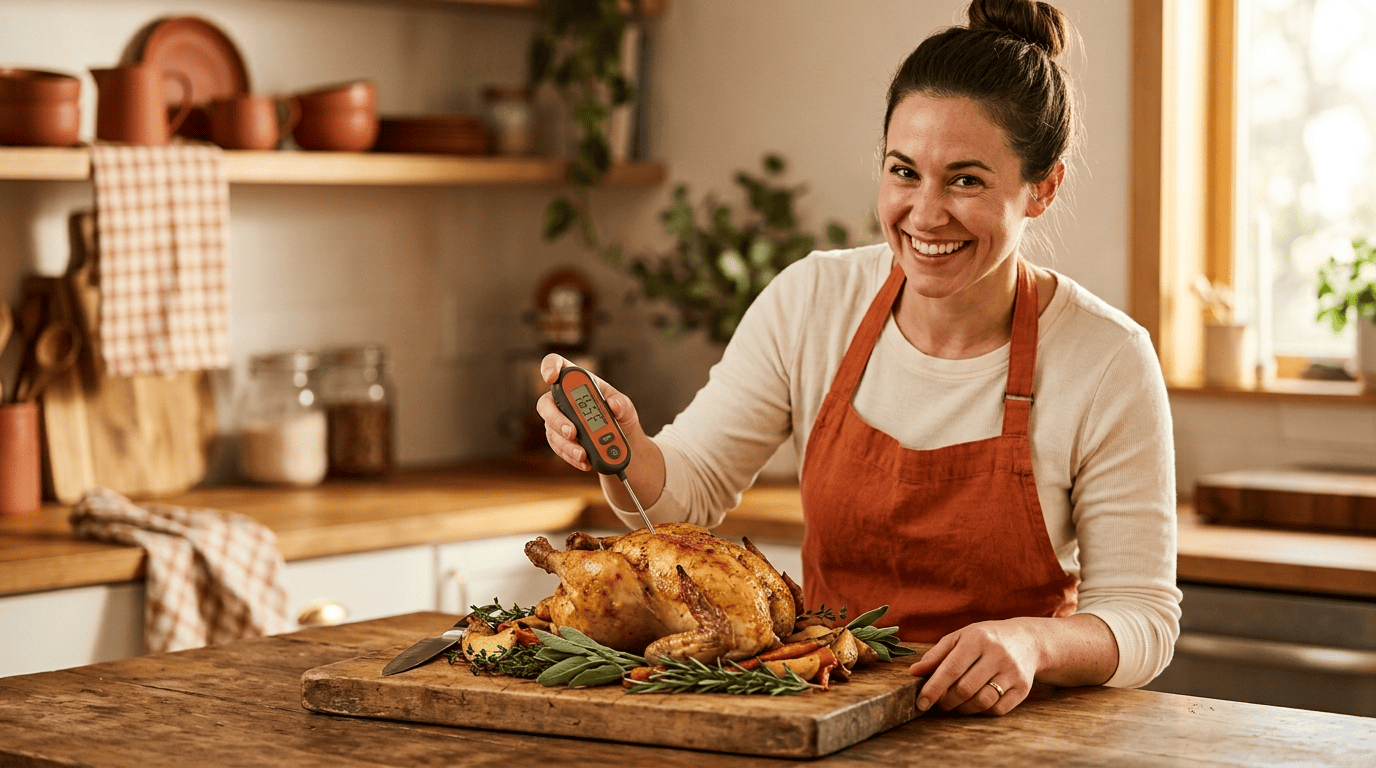
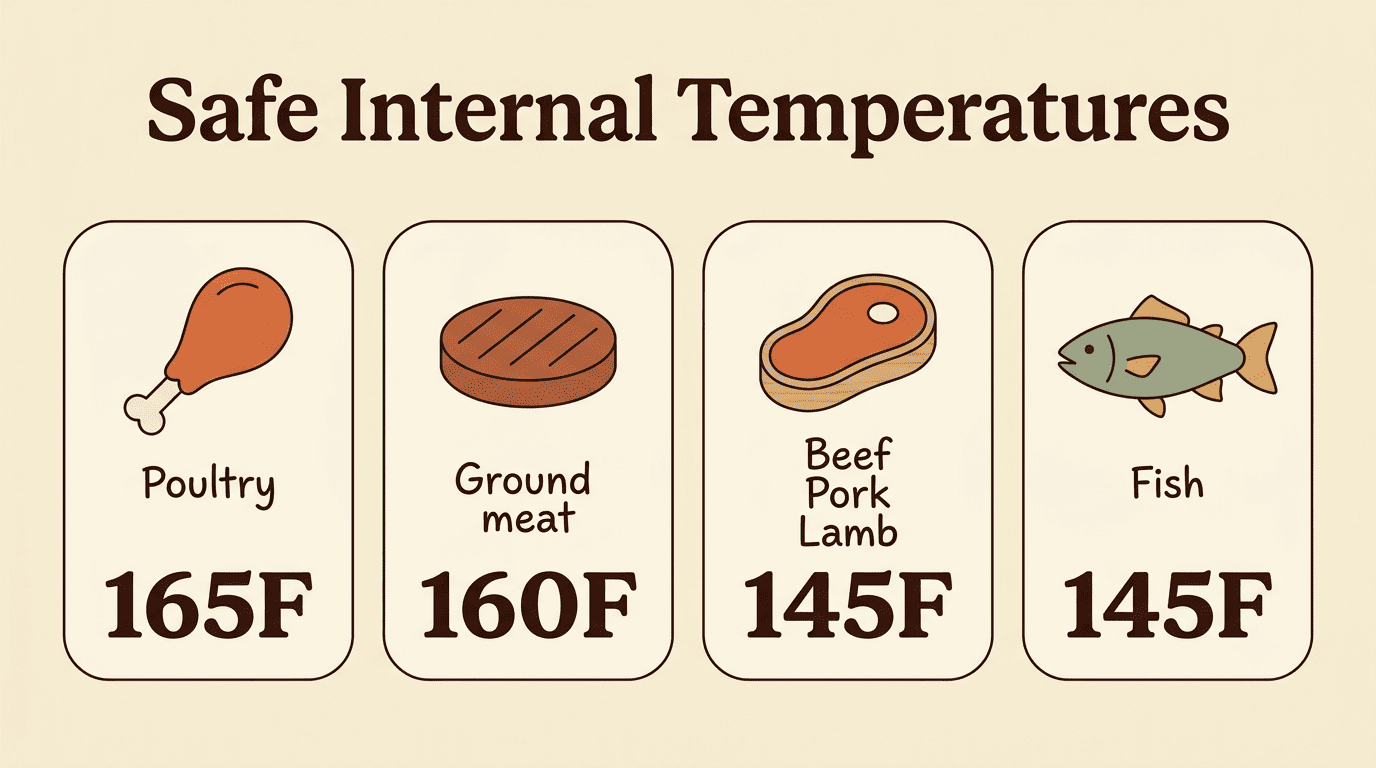
The short answer: poultry needs 165°F, ground meats need 160°F, whole cuts of beef, pork, lamb and veal need 145°F with a 3-minute rest, and fish needs 145°F. Anything sitting between 40°F and 140°F is in what food-safety experts call the “Danger Zone,” where bacteria multiply fastest.
Why Internal Temperature Is the Only Reliable Safety Check
Harmful bacteria — Salmonella, Campylobacter, Escherichia coli, and Clostridium perfringens — live on and in raw food, and they are killed only when the food actually reaches a safe internal temperature. Nothing else in the kitchen tells you that reliably. According to the CDC, foodborne illness affects roughly 1 in 6 Americans — about 48 million people — every year, and undercooked meat, poultry, and eggs are among the most common sources. The bacteria behind most of these cases include:
- Salmonella — commonly linked to poultry, eggs, and undercooked meat
- Campylobacter — the leading cause of bacterial foodborne illness, often tied to raw or undercooked chicken
- Escherichia coli (E. coli) — associated with undercooked ground beef
- Clostridium perfringens — thrives in food left in the Danger Zone too long, including leftovers
Color and time can fool you — temperature can’t
Browning on the outside of a chicken breast, juices running clear from a burger, or a timer hitting the number a recipe suggested — none of these confirm doneness. Pork can look pink and still be perfectly safe at 145°F, while a chicken thigh can appear fully browned and still carry live bacteria if it never reached 165°F inside. Cook time also swings with the thickness of the cut, the starting temperature of the food, and the quirks of your particular oven or grill. A food thermometer is the only tool that removes the guesswork and confirms the internal cooking temperature is where it needs to be. Unreliable doneness cues to stop trusting include:
- Juices running clear
- Meat turning from pink to brown or white
- The total time a recipe suggests
- How firm the meat feels to the touch
Ground meat needs more heat than a whole cut
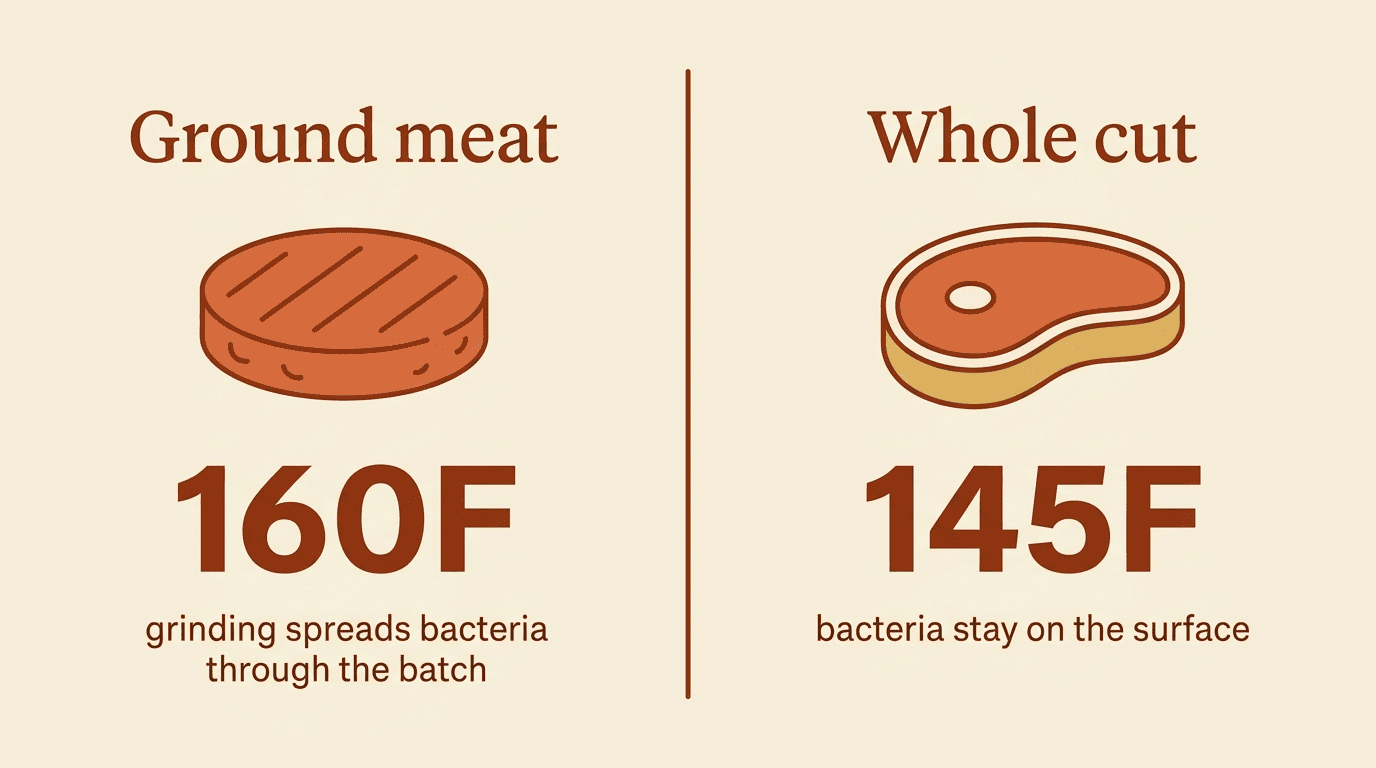
Grinding meat spreads any surface bacteria through the entire batch, not just the outside. That’s why ground beef, pork, and lamb must reach 160°F, while an intact steak or roast from the same animal is safe at a lower 145°F — the bacteria on a solid cut stay on the surface, where the heat of searing and cooking reaches them first. This single fact explains why the chart below lists two different numbers for what looks like the same protein.
The USDA Safe Minimum Internal Temperature Chart
This is the reference table home cooks actually need — copied straight from USDA FSIS and FoodSafety.gov guidance, with no rounding or guesswork.
| Food | Safe minimum internal temperature |
|---|---|
| All poultry (whole & ground: chicken, turkey, duck) | 165°F (74°C) |
| Ground meats (beef, pork, veal, lamb) | 160°F (71°C) |
| Beef, pork, veal & lamb — steaks, roasts, chops | 145°F (63°C) + rest 3 minutes |
| Fresh (raw) ham | 145°F (63°C) + rest 3 minutes |
| Precooked ham (to reheat) | 165°F (74°C) |
| Fish | 145°F (63°C) |
| Shellfish (shrimp, lobster, crab, scallops) | Cook until flesh is pearly/opaque |
| Shellfish (clams, oysters, mussels) | Cook until shells open |
| Eggs | Cook until yolk and white are firm |
| Egg dishes (casseroles, quiche) | 160°F (71°C) |
| Leftovers & casseroles | 165°F (74°C) |
Note that ground meats and whole cuts of the same animal carry different numbers on purpose, and poultry always sits at the top of the chart regardless of cut or grind. Precooked ham is the one exception where a lower-risk food still needs a higher reheat temperature, simply because it’s being warmed rather than cooked from raw.
The rest period after cooking isn’t just about juiciness — it’s part of the safety standard itself. As the USDA Food Safety and Inspection Service puts it directly:
Cook all raw beef, pork, lamb, and veal steaks, chops, and roasts to a minimum internal temperature of 145 °F as measured with a food thermometer before removing meat from the heat source. For safety and quality, allow meat to rest for at least three minutes before carving or consuming.
USDA Food Safety and Inspection Service
Poultry: always 165°F, no exceptions
Whole birds, breasts, thighs, wings, and ground chicken or turkey all need to reach 165°F (74°C). There is no pink-color exception here — dark meat can look done at a lower temperature but still isn’t safe. The thermometer, not the color of the meat near the bone, is what decides.
Beef, pork, and lamb: 145°F for whole cuts, 160°F for ground
Steaks, roasts, and chops from beef, pork, veal, or lamb are safe at 145°F once they rest for 3 minutes. Fresh pork has been safe at 145°F since 2011, when USDA lowered the standard from the older 160°F recommendation — modern pork production carries far less risk of trichinosis than it once did. Ground versions of these same meats still need the higher 160°F, and precooked ham that’s being reheated should reach 165°F.
Fish, eggs, and leftovers
Fish is done at 145°F, or when the flesh is no longer translucent. Shellfish don’t have a single target temperature — shrimp, lobster, crab, and scallops are done when the flesh turns pearly and opaque, and clams, oysters, and mussels are done when their shells open during cooking. Eggs should be cooked until both the yolk and the white are firm — no more runny centers if food safety is the goal — while egg dishes like casseroles and quiche need to hit 160°F throughout. Leftovers and casseroles being reheated should climb back to 165°F before serving.
The 3-Minute Rest — a Safety Step, Not Just for Juiciness
Once a beef, pork, lamb, or veal whole cut hits 145°F, it isn’t finished — it needs to rest for at least 3 minutes before carving or eating. During that rest, the temperature holds steady or even continues to climb slightly, and that extra time at heat is what finishes off any remaining pathogens on the surface. Skipping the rest and cutting in immediately effectively shortcuts the safety margin USDA built into the 145°F number. This rule applies specifically to whole cuts — it does not apply to poultry, which must already hit 165°F with no rest required, or to ground meat, which must reach 160°F outright.
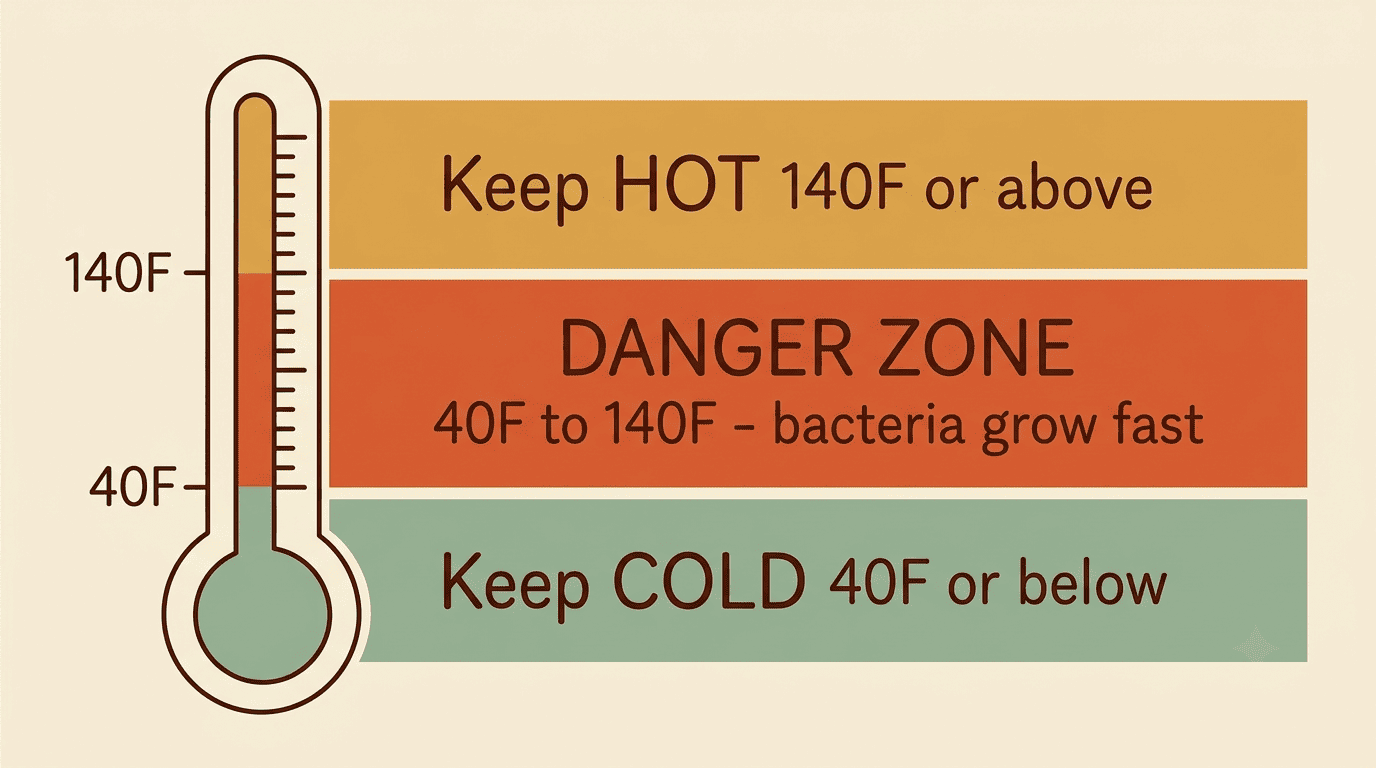
The Danger Zone: 40°F to 140°F
Cooking is only half of food safety — how food is held before and after cooking matters just as much. USDA FSIS defines the risk window plainly:
Bacteria grow most rapidly between the temperatures of 40 °F and 140 °F, doubling in number in as little as 20 minutes.
USDA Food Safety and Inspection Service
This 40°F–140°F range is what’s known as the food Danger Zone. Perishable food shouldn’t sit in it for more than 2 hours — or just 1 hour if the ambient temperature is above 90°F, such as at an outdoor picnic. Hot food needs to be held at 140°F or above, and cold food needs to stay at 40°F or below, to stay outside that window. This matters both while food is actively cooking and afterward, whenever it’s cooling, resting on a counter, or sitting in a buffet line.
| Situation | Safe holding rule |
|---|---|
| Hot food on the counter or buffet | Hold at 140°F or above |
| Cold food on the counter or buffet | Hold at 40°F or below |
| Perishable food at room temperature | Discard after 2 hours |
| Perishable food above 90°F (picnics, hot cars) | Discard after 1 hour |
| Refrigerator temperature | Keep at or below 40°F |
Practical ways to keep food out of the Danger Zone at home:
- Refrigerate leftovers within 2 hours of cooking (1 hour in hot weather)
- Keep the refrigerator at 40°F or below and the freezer at 0°F or below
- Use a slow cooker or chafing dish to hold hot food above 140°F at gatherings
- Never thaw meat on the counter — thaw in the refrigerator, cold water, or the microwave
How to Use a Food Thermometer Correctly
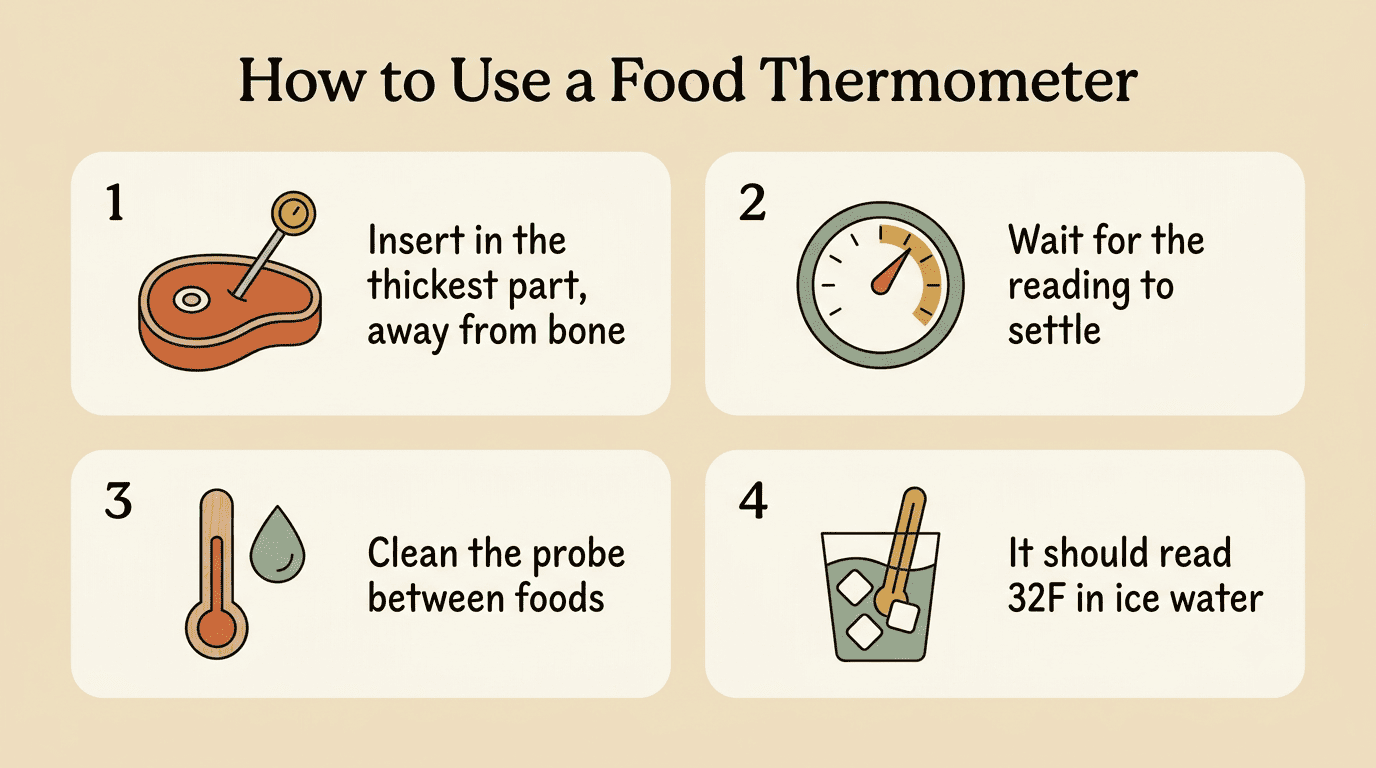
A thermometer only gives an accurate reading if it’s used the right way. Follow these steps for a reliable check every time:
- Insert the probe into the thickest part of the food, away from bone, fat, and gristle — those areas heat differently and give false readings.
- For thin foods like burger patties or chicken breasts, insert the thermometer sideways to reach the center.
- Wait a few seconds for the reading to stabilize before checking the number.
- Check more than one spot on larger items, like a whole turkey, to confirm even cooking.
- Clean the probe with hot, soapy water between foods to avoid cross-contamination.
- Choose the right type for the job — instant-read for a quick spot-check, leave-in probe thermometers for roasts and whole birds that cook for hours.
- Calibrate periodically by placing the probe in a glass of ice water; it should read 32°F (0°C).
Cooking From an AI Recipe? Verify the Temperature Against USDA
An AI recipe maker like Nora is great for meal ideas, ingredient substitutions, and scaling a recipe up or down for a bigger crowd — but it’s a planning tool, not a food-safety authority. Suggested cook times from any recipe, AI-generated or not, are estimates based on typical conditions; your oven, your cut of meat, and your starting temperature will always vary slightly. Always confirm the finished dish against the USDA safe minimum internal temperature chart with an actual thermometer before serving. What an AI recipe tool is, and isn’t, good for:
- Good for: ingredient swaps, portion scaling, flavor pairings, meal planning
- Good for: reminding you which USDA temperature applies to a given protein
- Not a substitute for: an actual thermometer reading at the end of cooking
- Not a substitute for: judging doneness by suggested minutes alone
A good habit when using an AI recipe app is to ask it to include the USDA safe temperature for whatever protein you’re cooking, then treat that number — not the suggested minutes on the timer — as the real finish line. Never rely on cook time alone, no matter how detailed the recipe sounds.