
Ingredient Substitutions: A Friendly Guide (and How an AI Recipe Generator Nails the Swap)
Out of buttermilk? Down to your last egg? Almost every ingredient has a stand-in that keeps your dish on track. An AI recipe generator can suggest the right swap in seconds, matched to what you have on hand and the taste or texture you’re after.

Most ingredient substitutions work close to one-to-one, but they can still shift flavor, texture, color, or how much a batter rises — baking is by far the most sensitive category. Below you’ll find the swaps home cooks reach for most, a quick reference chart, and how AI narrows down the best option for your specific recipe.
The one rule behind every good substitution
Every ingredient in a recipe is doing a job. Eggs bind and add moisture and lift. Butter carries fat and flavor while trapping air when creamed. Baking soda and baking powder create lift through a chemical reaction. Flour builds structure. A good ingredient substitution isn’t just about matching flavor — it’s about finding something that can step into that same role.
That’s why the same swap can work beautifully in one recipe and fall flat in another. A muffin tolerates a change in fat much better than a delicate sponge cake does, because the sponge depends on precise structure and volume. As the NDSU Extension guide to ingredient substitutions puts it:
Substitution of one ingredient for another may alter the taste, color, moisture content or texture of the product.
NDSU Extension, FN198
Keep that in mind and you’ll pick better swaps: ask what job the missing ingredient is doing, then look for something that can do it too.
Egg substitutes for baking
Eggs do three things at once in most batters: they bind ingredients together, add moisture, and help the mixture rise. A good egg substitute needs to cover at least one or two of those jobs, which is why the right pick depends on what you’re making.
For binding and a denser, heartier crumb, use 1 tablespoon of ground flaxseed mixed with 3 tablespoons of water per egg. Let it sit for a few minutes until it turns gel-like. This works well in muffins, pancakes, and quick breads, though the result tends to be slightly denser than one made with real eggs.
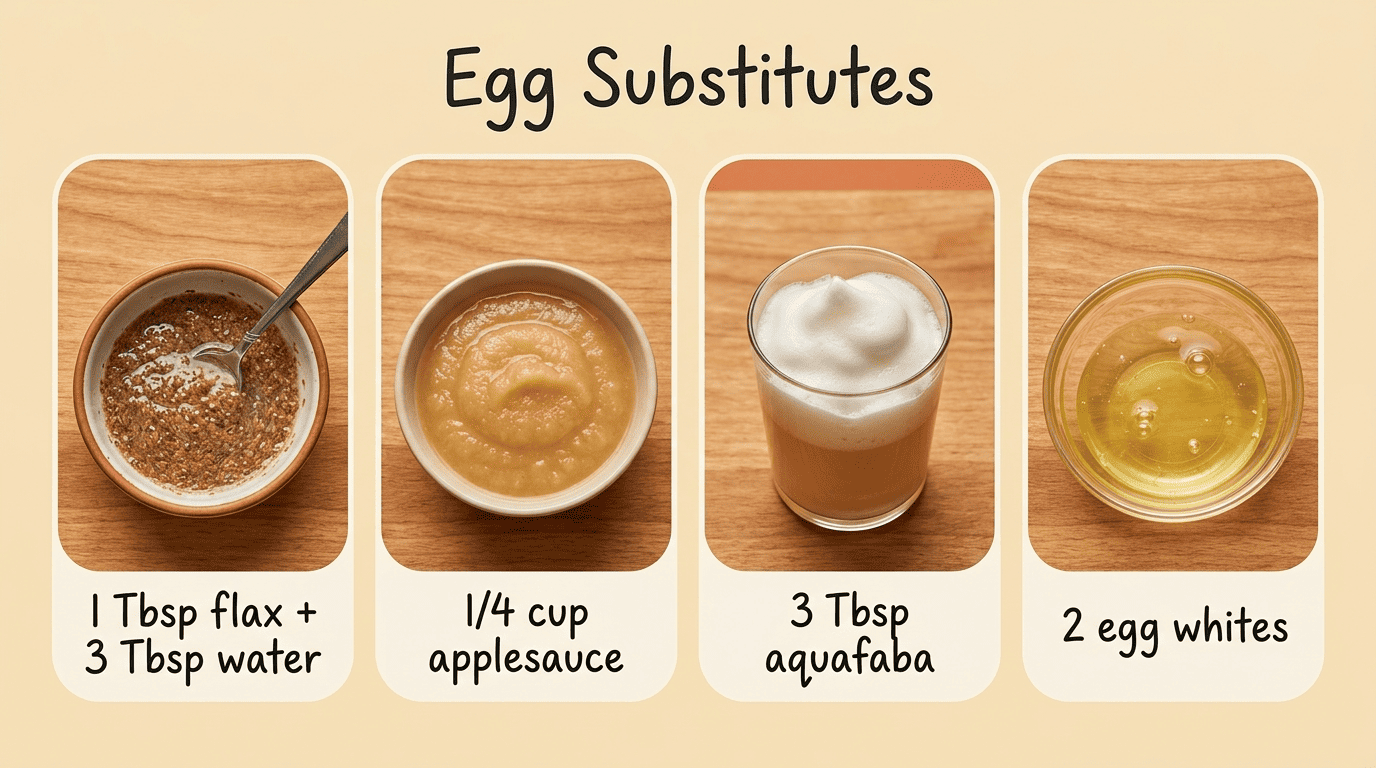
For extra moisture and a touch of natural sweetness, swap in 1/4 cup of unsweetened applesauce or mashed banana per egg. It’s a favorite in banana bread and spice cakes, but skip it in recipes that already rely on eggs for structure, like custards.
For lift in meringues and light bakes, 3 tablespoons of aquafaba — the liquid from a can of chickpeas — whips up remarkably like egg whites and is a go-to for vegan meringues and mousses.
If you’re cutting back on cholesterol rather than avoiding eggs entirely, 2 egg whites or 1/4 cup of a commercial egg substitute can typically replace 1 whole egg in most recipes.
- Flax or chia egg: 1 Tbsp ground flax or chia + 3 Tbsp water, rested until gel-like.
- Applesauce or mashed banana: 1/4 cup per egg.
- Aquafaba: 3 Tbsp per egg.
- Egg whites or egg substitute: 2 egg whites or 1/4 cup per whole egg.
Butter, oil & dairy-fat swaps
Butter brings fat, flavor, and — when it’s creamed with sugar — trapped air that helps baked goods rise. Replace it with something that skips the creaming step, and the texture will change even if the taste holds up.
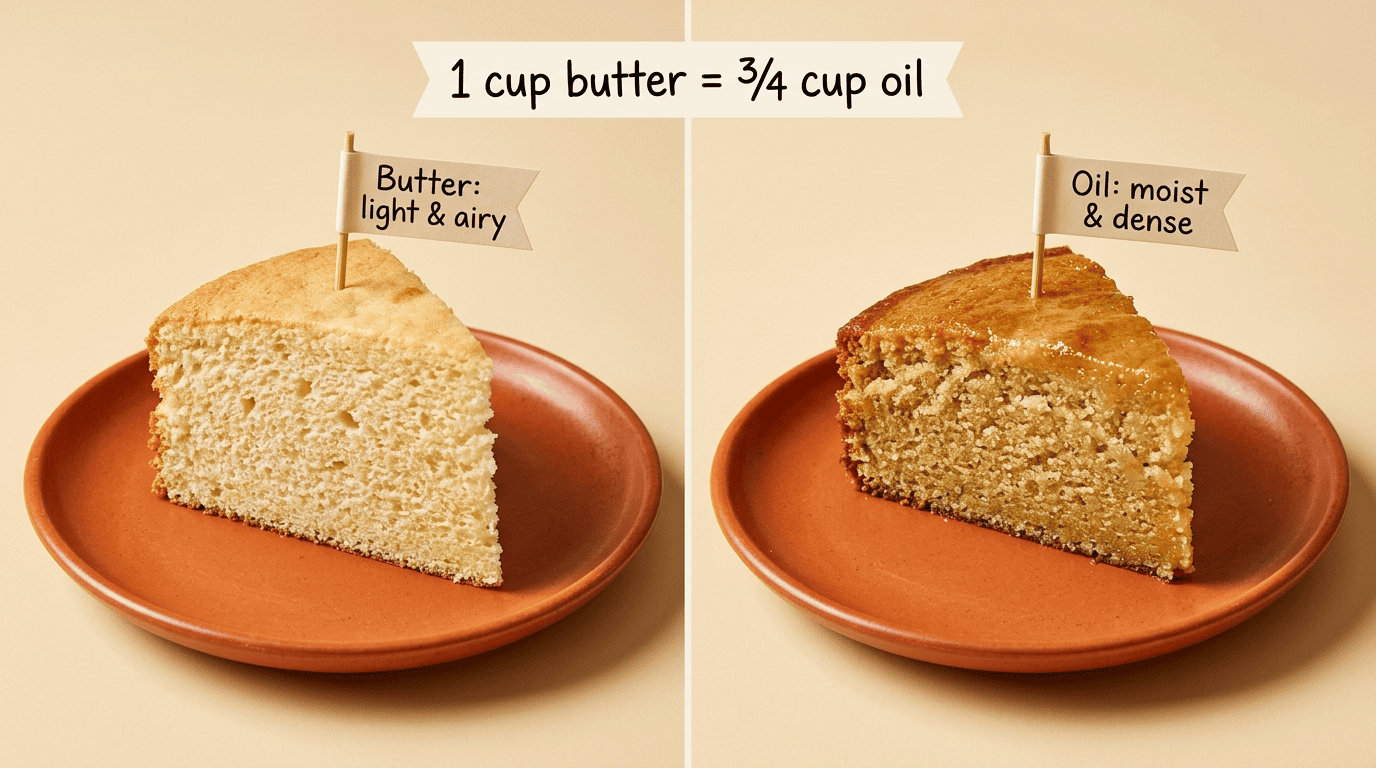
Can I substitute oil for butter in baking? Yes, and it’s one of the most common substitutions in home kitchens. Use about 3/4 cup of neutral oil for every 1 cup of butter. Because oil is liquid at room temperature, it can’t hold air the way creamed butter does, so cakes and cookies made with oil come out moister and denser rather than light and airy.
For a lighter, healthier version of a recipe, try replacing half the butter — not all of it — with an equal amount of unsweetened applesauce or prune purée. This cuts fat without collapsing the structure entirely. Greek yogurt and mashed avocado are two other solid stand-ins, especially in muffins and brownies where a slightly fudgier texture isn’t a problem.
Buttermilk, milk & dairy-free options
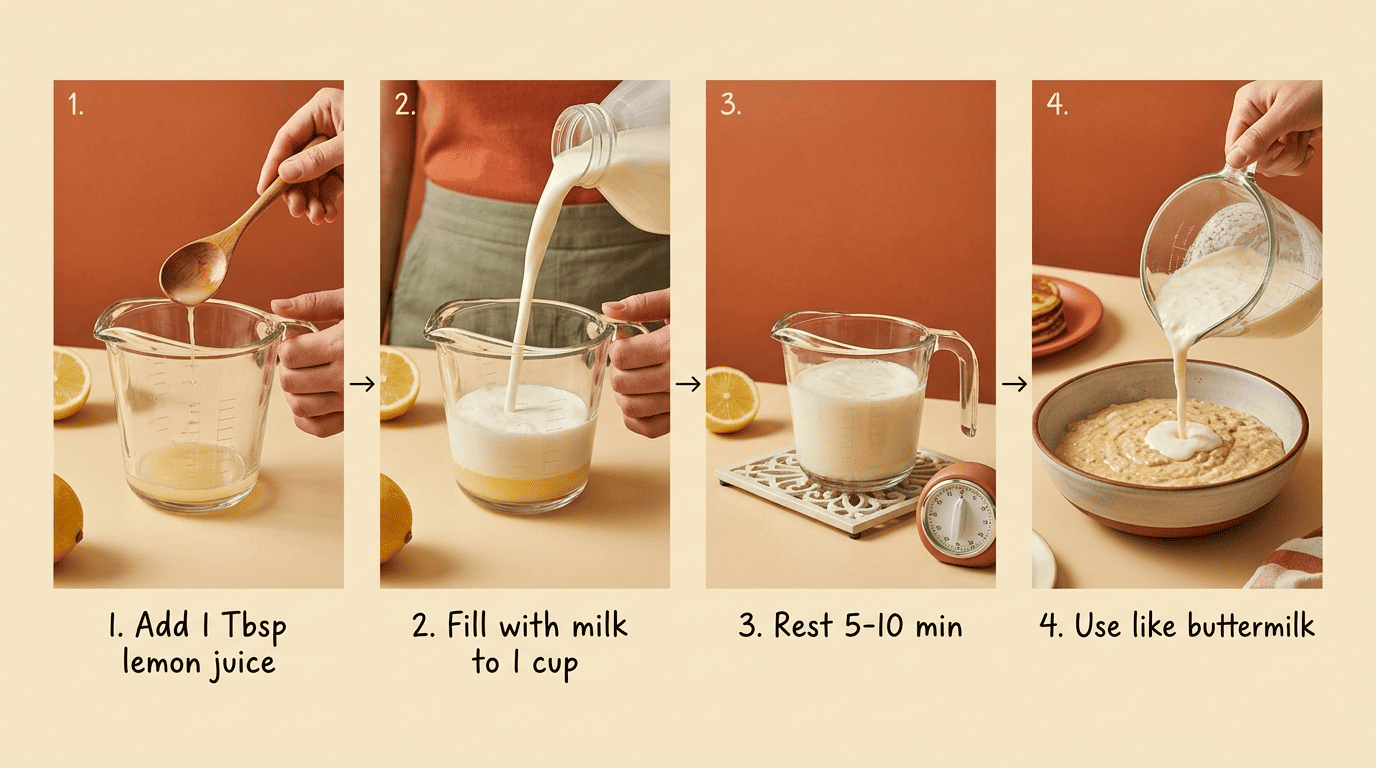
How do you substitute buttermilk? The classic fix is souring regular milk, and it only takes a few steps:
- Measure 1 tablespoon of lemon juice or white vinegar into a 1-cup liquid measuring cup.
- Fill the rest of the cup with milk (dairy or dairy-free) up to the 1-cup line.
- Stir gently and let it rest for 5 to 10 minutes, until it looks slightly curdled.
- Use it exactly as you would store-bought buttermilk, cup for cup.
The acid curdles the milk slightly and mimics the tang and chemical reaction real buttermilk provides, which is what activates baking soda in a recipe. Plain yogurt, used 1:1, is another reliable option.
According to Wikipedia’s overview of buttermilk, traditional cultured buttermilk is fermented by bacteria that thicken the milk and add tang, while the DIY acidified version simply mimics that acidity without the fermentation — close enough for almost any recipe, but not identical in flavor.
Sour cream substitutes just as easily: swap in plain yogurt at a 1:1 ratio. For dairy-free cooking, soy, oat, or almond milk can replace regular milk 1:1 in most recipes; to recreate the buttermilk effect, just add 1 tablespoon of an acid like lemon juice or vinegar to your dairy-free milk of choice and let it sit.
Sugar & sweetener swaps
- Honey for sugar: use 1 1/4 cups of sugar plus 1/4 cup of extra liquid for every 1 cup of honey called for — honey is sweeter and adds moisture, so you need to rebalance both. Going the other direction, replacing honey with sugar, means adding back roughly 1/4 cup of liquid elsewhere in the recipe.
- Brown sugar for white sugar: swap 1:1, but expect more moisture and a deeper, caramel-like flavor thanks to the molasses in brown sugar.
- Maple syrup or other liquid sweeteners: because they add water, most bakers lower the oven temperature by about 25°F and watch for faster browning.
Liquid sweeteners like honey and maple syrup also brown faster in the oven than granulated sugar does, so keep an eye on your bake time. If you’re substituting sweeteners to cut back on added sugar generally, the Harvard T.H. Chan School of Public Health’s Nutrition Source is a solid, non-commercial reference on moderating added sugar in everyday cooking.
Baking basics: flour, leavening & thickeners
Baking is the category where substitutions matter most, because leavening and structure are governed by precise chemistry rather than taste preference. A batter that’s supposed to rise a certain amount, at a certain rate, can fall flat or turn gummy if you get a swap wrong.
Flour and starch swaps
Don’t have cake flour? Combine 1 cup of all-purpose flour minus 2 tablespoons, then add 2 tablespoons of cornstarch — this lowers the protein content enough to mimic cake flour’s tender crumb. As a thickener, 1 tablespoon of cornstarch can replace 2 tablespoons of all-purpose flour in sauces and pie fillings, since cornstarch thickens more powerfully with less starch needed.
Leavening agents
If you’re out of baking powder, mix 1/4 teaspoon of baking soda with 5/8 teaspoon of cream of tartar to make 1 teaspoon of baking powder. One important warning: self-rising flour already contains both baking powder and salt baked in, so never add extra leavening on top of it — you’ll end up with an overly puffed, salty result.
For chocolate, 1 ounce of unsweetened chocolate can be replaced with 3 tablespoons of cocoa powder plus 1 tablespoon of fat (butter or oil), which restores the richness the cocoa alone is missing.
Herbs, spices & flavor swaps
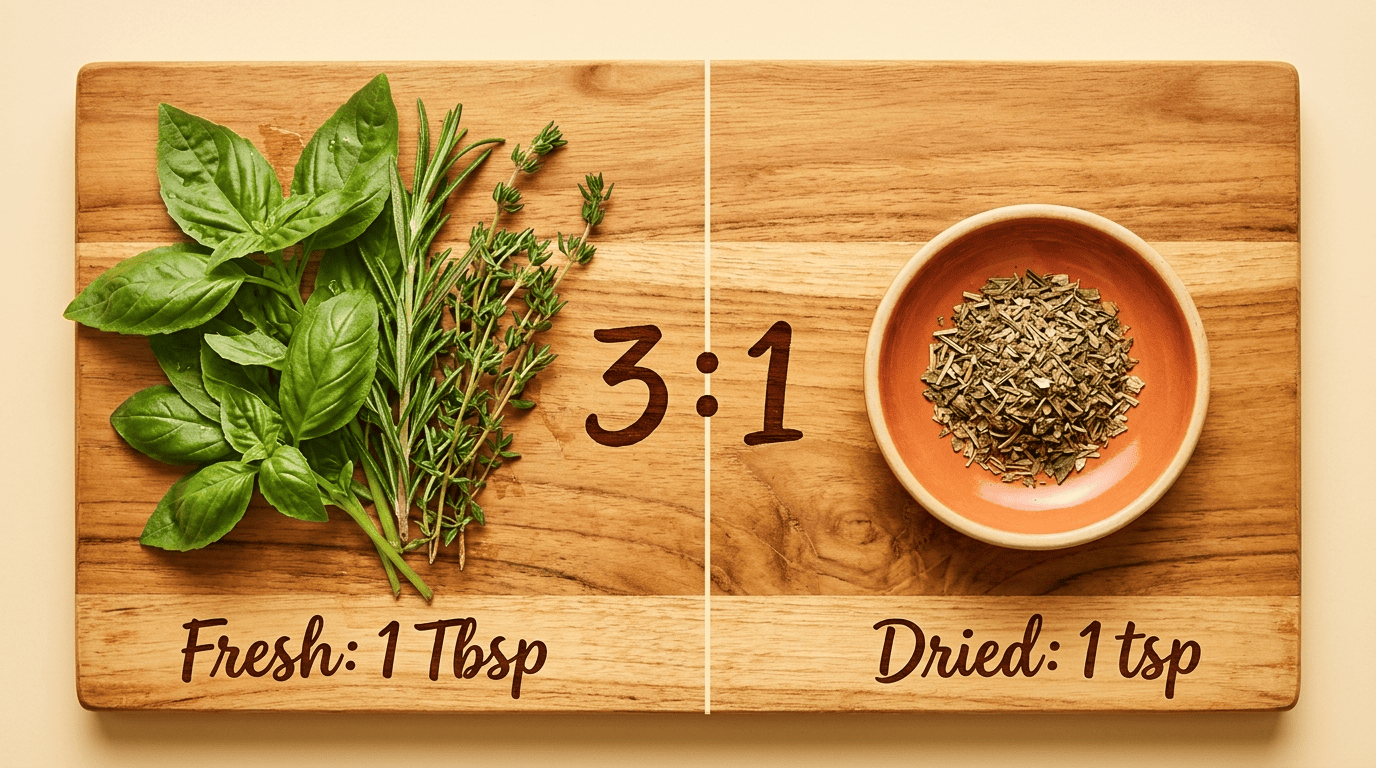
Fresh herbs deliver a brighter, lighter flavor, while dried herbs are more concentrated. The standard conversion is 3:1 — use 1 teaspoon of dried herbs for every 1 tablespoon of fresh called for in a recipe. Add dried herbs early in cooking so they have time to rehydrate and release flavor; stir fresh herbs in near the end so they don’t wilt or turn bitter.
Spice blends have their own logic too. No allspice on hand? Combine 1/2 teaspoon of cinnamon with 1/2 teaspoon of cloves to approximate 1 teaspoon of allspice. Warm spices like cinnamon, nutmeg, and cardamom tend to swap well with one another, and woody herbs — rosemary, thyme, and oregano — are largely interchangeable in savory dishes where you want an earthy backbone rather than a specific herb’s exact flavor.
When a recipe calls for a specific herb you simply don’t like, it’s usually safe to swap within its flavor family rather than skip it entirely, which keeps the dish balanced instead of one-note.
| Missing spice/herb | Substitute |
|---|---|
| Allspice, 1 tsp | 1/2 tsp cinnamon + 1/2 tsp cloves |
| Fresh herbs, 1 Tbsp | 1 tsp dried herbs |
| Rosemary | Thyme or oregano |
| Cinnamon | Nutmeg or cardamom (warm-spice family) |
How an AI recipe generator picks the right substitution
This is where things get genuinely useful. A printed chart can tell you that 1 cup of buttermilk equals 1 tablespoon of lemon juice plus milk — but it can’t tell you whether that swap makes sense for your specific pancake recipe, your dietary restrictions, or the three other ingredients already sitting on your counter.

An AI recipe generator works differently. It starts by identifying the role the missing ingredient plays in the recipe — binding, moisture, leavening, fat, or flavor — then cross-references what you actually have available, along with any preferences you’ve set, like vegan, gluten-free, dairy-free, or low-sugar. From there it doesn’t just name a substitute; it recalculates the quantities, and often flags adjustments to baking time or oven temperature that a straight ingredient swap requires.
Say you tell it, “I’m out of eggs and I’m vegan.” Rather than returning a generic list, it can zero in on a flax egg, adjust the recipe’s liquid ratio to compensate for the extra water, and note that the texture will come out slightly denser — the same reasoning a knowledgeable friend in the kitchen would walk you through. That’s the real advantage of trying our AI recipe generator over a static substitution list: it reasons about your recipe, not just the ingredient in isolation.
Quick ingredient substitution chart
| Ingredient | You need | Substitute |
|---|---|---|
| Buttermilk | 1 cup | 1 Tbsp lemon juice or vinegar + milk to 1 cup, rest 5–10 min |
| Egg | 1 egg | 1 Tbsp ground flax + 3 Tbsp water, or 1/4 cup applesauce, or 3 Tbsp aquafaba |
| Butter | 1 cup | 3/4 cup oil, or 1 cup Greek yogurt/applesauce (for half the amount) |
| Cake flour | 1 cup | 1 cup AP flour minus 2 Tbsp + 2 Tbsp cornstarch |
| Baking powder | 1 tsp | 1/4 tsp baking soda + 5/8 tsp cream of tartar |
| Cornstarch (thickener) | 1 Tbsp | 2 Tbsp all-purpose flour |
| Honey | 1 cup | 1 1/4 cups sugar + 1/4 cup extra liquid |
| Sour cream | 1 cup | 1 cup plain yogurt |
| Heavy cream | 1 cup | 3/4 cup milk + 1/4 cup melted butter (for cooking, not whipping) |
| Unsweetened chocolate | 1 oz | 3 Tbsp cocoa powder + 1 Tbsp fat |
| Fresh herbs | 1 Tbsp | 1 tsp dried herbs |
For swaps tailored to the exact recipe in front of you, rather than a generic ratio, try the free AI recipe generator — it factors in your diet, pantry, and the dish you’re actually making.
Limits: when a substitution won’t work
Not every ingredient is safely replaceable, and it’s worth being upfront about that. Baking remains the riskiest category because leavening, gluten structure, and fat content are all calibrated precisely — swapping eggs, flour, or fat in a delicate sponge cake or macaron can lead to sinking, a gummy crumb, or a crust that never forms properly.
A few situations where substitutions are especially risky:
- Deep frying — the substitute needs a high smoke point, or it will burn and smoke instead of crisping food properly.
- Gelatin vs. agar-agar — both set liquids, but they behave differently with acidic ingredients and set at different temperatures, so a straight swap can fail to set at all.
- Structural bakes — soufflés, macarons, and angel food cake depend on exact egg-white volume and can’t tolerate an egg substitute.
- Candy-making — sugar substitutes often don’t caramelize or crystallize the same way, throwing off the final texture entirely.
When you’re working with a precise or professional-style recipe, it’s often better not to substitute at all, or to test the swap in a small batch first. This is another place an AI recipe generator earns its keep — it can flag ahead of time when a substitution is likely to cause a structural problem rather than just a flavor shift.
A friendly note on food allergies
If you’re swapping an ingredient because of an allergy or intolerance rather than convenience, it’s worth taking an extra beat. Always read the label on whatever you’re substituting in — even products marketed as “dairy-free” or “nut-free” can carry cross-contact warnings, and ingredient lists change between brands and batches.
The FDA recognizes 9 major food allergens: milk, eggs, fish, shellfish, tree nuts, peanuts, wheat, soybeans, and sesame (sesame was added most recently, under the FASTER Act). You can find plain-language details on the FDA’s food allergies page, and general food-safety guidance at FoodSafety.gov. When in doubt, a naturally allergen-free swap is always the safer bet than trying to “make do” with something that might carry trace amounts of what you’re avoiding.