
AI Gluten-Free Recipe Generator: Safe, Custom Meals Without the Guesswork
Cooking gluten-free means every ingredient has to earn its place — and an AI recipe generator takes the mental math out of it, turning what’s in your kitchen into a safe, gluten-free meal in seconds. This guide shows how an AI gluten-free recipe generator works, which foods hide gluten according to the gluten-free diet framework, the flour swaps that actually bake, and the one safety step no tool can do for you.

Whether you have celiac disease, non-celiac gluten sensitivity, or you’re cooking for someone who does, the goal is the same — flavor without risk. Here’s how to get there with a little help from AI.
How an AI Gluten-Free Recipe Generator Actually Works
An AI-powered gluten-free recipe generator takes two inputs — what’s in your kitchen and what you can’t eat — and turns them into a finished recipe instead of a search results page. It works by matching your ingredients and dietary restriction against a large model of recipes and substitutions, then reasoning out quantities, steps, and cook time on the fly. Some tools respond in about 10 seconds, others take closer to 30, depending on how much detail you feed them.
You type what you have (most tools need 3–4 ingredients minimum), set the diet to “gluten-free,” add servings, cook time, and spice level, and the model returns a full recipe with quantities and steps in about 10–30 seconds. This is reverse-search cooking: instead of hunting for a recipe that happens to use your ingredients, you hand the ingredients over and the tool builds the recipe around them, filtering against a database of verified gluten-free ingredients as it goes. The underlying concept it’s working from is the same one described on the gluten-free diet page — eliminating wheat, barley, and rye proteins from every dish.
A good generator excludes gluten-containing grains and flags allergens rather than just omitting a word from the output. It’s trained on a wide base of recipe and ingredient data, which lets it swap flours, adjust binders, and rebalance liquids automatically. But it’s worth being clear-eyed about what that means in practice: the AI is reasoning about ingredients on paper, it does not test the food in a lab. That distinction matters more than it sounds — more on why in the safety section below.
What Foods Actually Contain Gluten
Gluten is a protein that shows up in specific grains, plus a long list of everyday products that borrow from them. Knowing the obvious sources and the sneaky ones is what actually keeps a gluten-free kitchen gluten-free.
| Food or drink | Contains gluten? | Why |
|---|---|---|
| Wheat, barley, rye, triticale | Yes | Gluten proteins are native to these grains |
| Malted cereals (cornflakes, puffed rice) | Often | Barley malt is added as a flavoring |
| Soy sauce, beer, ale, malt drinks | Usually | Brewed or fermented from barley or wheat |
| Wine, distilled spirits, hard cider | No | The distilling and fermenting process leaves gluten proteins behind |
| Plain oats | Naturally no | But frequently cross-contaminated during growing and milling |
The obvious four: wheat, barley, rye, triticale
Gluten is a protein in wheat (including spelt, farro, durum, and semolina), barley, rye, and the wheat-rye hybrid triticale. On an ingredient label, watch for these everyday aliases:
- Wheat: spelt, farro, durum, semolina, graham, bulgur
- Barley: malt, malt extract, malt vinegar, brewer’s yeast
- Rye: rye flour, rye bread, pumpernickel
- Triticale: usually listed under its own name, a wheat-rye cross
They’re all wheat, barley, or rye wearing a different name, and they’re the reason a “flour” or “malt” listing deserves a second look before it goes in the cart.
The sneaky sources: malt, soy sauce, oats, and “wheat-free”
Barley malt hides in cornflakes and puffed-rice cereals — products that look grain-simple but aren’t. Most soy sauce, beer, ale, and malt drinks contain gluten, while wine, distilled spirits, and hard cider do not. Oats are naturally gluten-free but frequently cross-contaminated with wheat during growing and milling, and avenin — a protein unique to oats — triggers a reaction in some people with celiac disease; most tolerate up to about ½ cup of dry certified gluten-free oats a day.
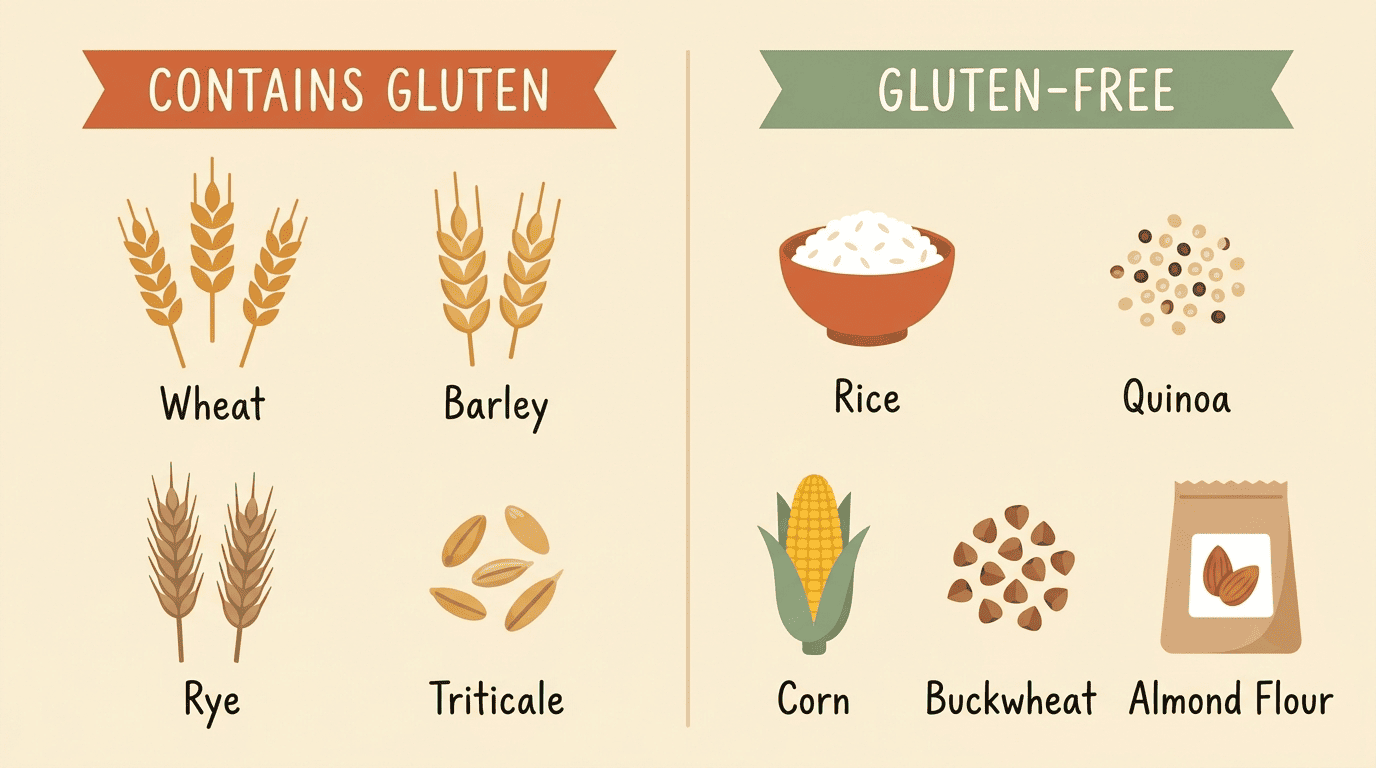
One label distinction is worth memorizing: “wheat-free” is not the same as “gluten-free” — a product can drop wheat and still contain barley or rye, so a wheat-free claim alone tells you nothing about safety.
Gluten-Free Flour Substitutes That Actually Bake
Baking is where gluten-free cooking gets technical — gluten is what gives bread its stretch and cakes their crumb, so replacing it takes more than swapping in a single flour. Here’s the flour math worth knowing before you preheat the oven.
| Flour | How it swaps | Notes |
|---|---|---|
| Almond | 1:1, plus one extra egg | ~590 cal/100g vs. ~360 for wheat; skip if nut-allergic |
| Coconut | ¼–⅓ cup per 1 cup wheat flour | Very absorbent — add extra liquid and eggs |
| Rice (white/brown) | Blend with tapioca | Gritty texture when used alone |
| Sorghum | Base flour in a blend | Mild flavor, protein- and iron-rich, cultivated for roughly 5,000 years |
| Tapioca / potato starch | Part of the blend, not the base | Adds lightness and a crisp crust |
| Teff, buckwheat, amaranth | 25–50% of the blend | Pseudocereals; teff is a tiny grain — about 1/100th the size of a wheat kernel — and notably high in calcium |
No single flour replaces wheat — you blend
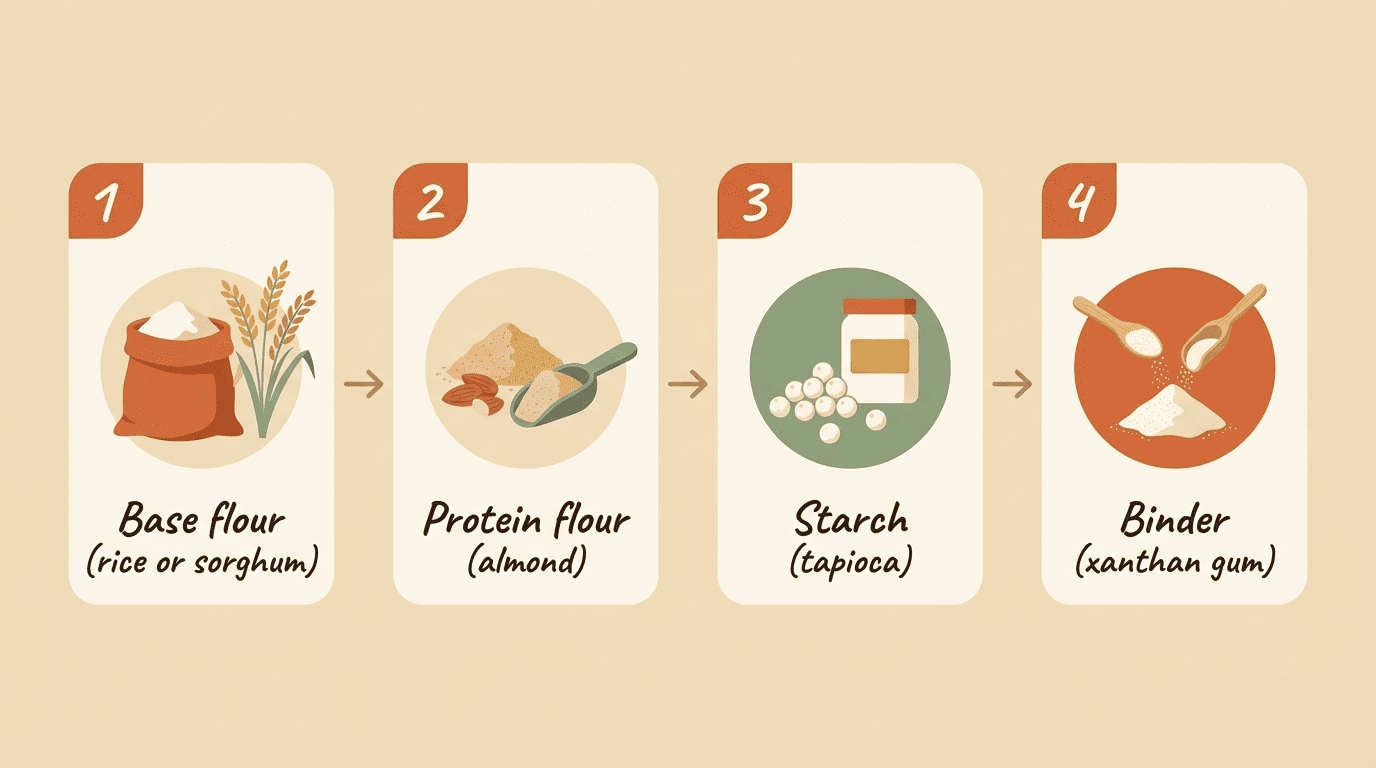
Wheat’s gluten gives baked goods structure and stretch; no single gluten-free flour does that job alone, which is why every reliable gluten-free recipe generator works from a blend rather than a straight swap. The reliable formula is a heavier base flour (brown rice or sorghum) plus a protein flour (almond) plus a starch (tapioca or potato) plus a binder like xanthan gum. A sample blend that holds up in baking: 3 cups almond flour, 1½ cups arrowroot or potato starch, ¾ cup coconut flour, and ¾ cup tapioca starch, bound together with a spoonful of xanthan gum.
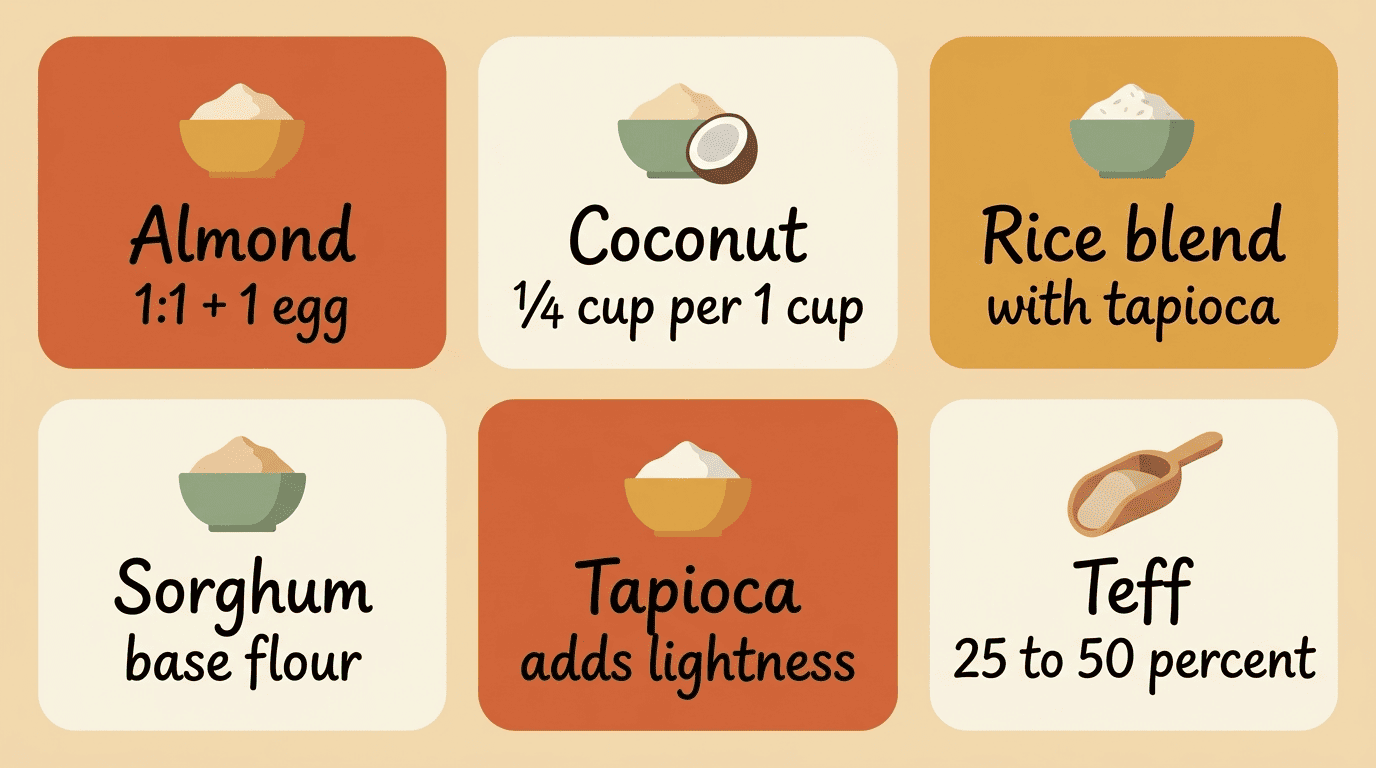
Getting the ratio wrong shows up fast — too little starch and the crumb turns dense and gritty, too little binder and the dough won’t hold together without extra egg to compensate. That’s the exact calculation an AI gluten-free recipe generator can run for you once you tell it which flours are actually in your pantry. The blend breaks down into four distinct jobs:
- Base flour (brown rice, sorghum) — bulk and everyday structure
- Protein flour (almond) — richness and a tighter crumb
- Starch (tapioca, potato) — lightness and a crisp crust
- Binder (xanthan gum) — stands in for the stretch gluten normally provides
A quick way to see how the pieces fit: each flour in the table above plays one role — bulk, protein, lightness, or binding — and a gluten-free recipe generator essentially automates that math, scaling the blend to whatever quantity your recipe calls for instead of you doing the ratio by hand.
How to Tell the AI to Keep It Gluten-Free
Getting a genuinely safe result out of an AI tool comes down to how precisely you set it up — vague instructions produce vague filtering.
Choose the “gluten-free” preset instead of typing it into a notes field. A structured diet filter tells the model to exclude wheat, barley, rye, and their derivatives at the ingredient-matching stage, not just skim for the word in your prompt. List any secondary allergies too — nuts, dairy — so it swaps out almond flour or butter automatically if needed, then add whatever you actually have on hand.
Give it a specific example prompt to work from. Something like: “Gluten-free dinner for two, 30 minutes, mild spice, I have chicken thighs, rice, and bell peppers, no nuts” gives the model everything it needs to filter correctly on the first try instead of guessing.
Ask it to flag risky ingredients
Prompt it to call out anything that commonly hides gluten so you know exactly what to double-check on the label before it goes in the pan:
- Soy sauce → ask for tamari, or confirm the bottle says “gluten-free”
- Broth or bouillon → some brands thicken with wheat
- Oats → must be labeled “certified gluten-free,” not just “oats”
- Seasoning blends and gravies → wheat flour is a common thickener
This step matters because the AI can pick the right category of ingredient, but it can’t see the actual box sitting in your pantry — that check is still yours to make.
Cross-Contamination: The One Thing AI Can’t Do for You
This is the section that separates a fun kitchen shortcut from a genuinely safe one, especially if celiac disease is in the picture.
What the “gluten-free” label really means
In the U.S., the FDA’s gluten-free labeling rule lets a product carry the “gluten-free” claim only if it contains less than 20 parts per million of gluten, a final rule published in 2013, with compliance required from 2014 on. Products with a “certified gluten-free” seal are often held to a stricter standard, frequently under 10 ppm.
Be careful with softer claims: “made without gluten” or “wheat removed” are not the same guarantee, and products carrying those phrases may not be celiac-safe. For a fuller picture of which foods and ingredient categories are considered safe, the Celiac Disease Foundation keeps a reference list worth bookmarking.
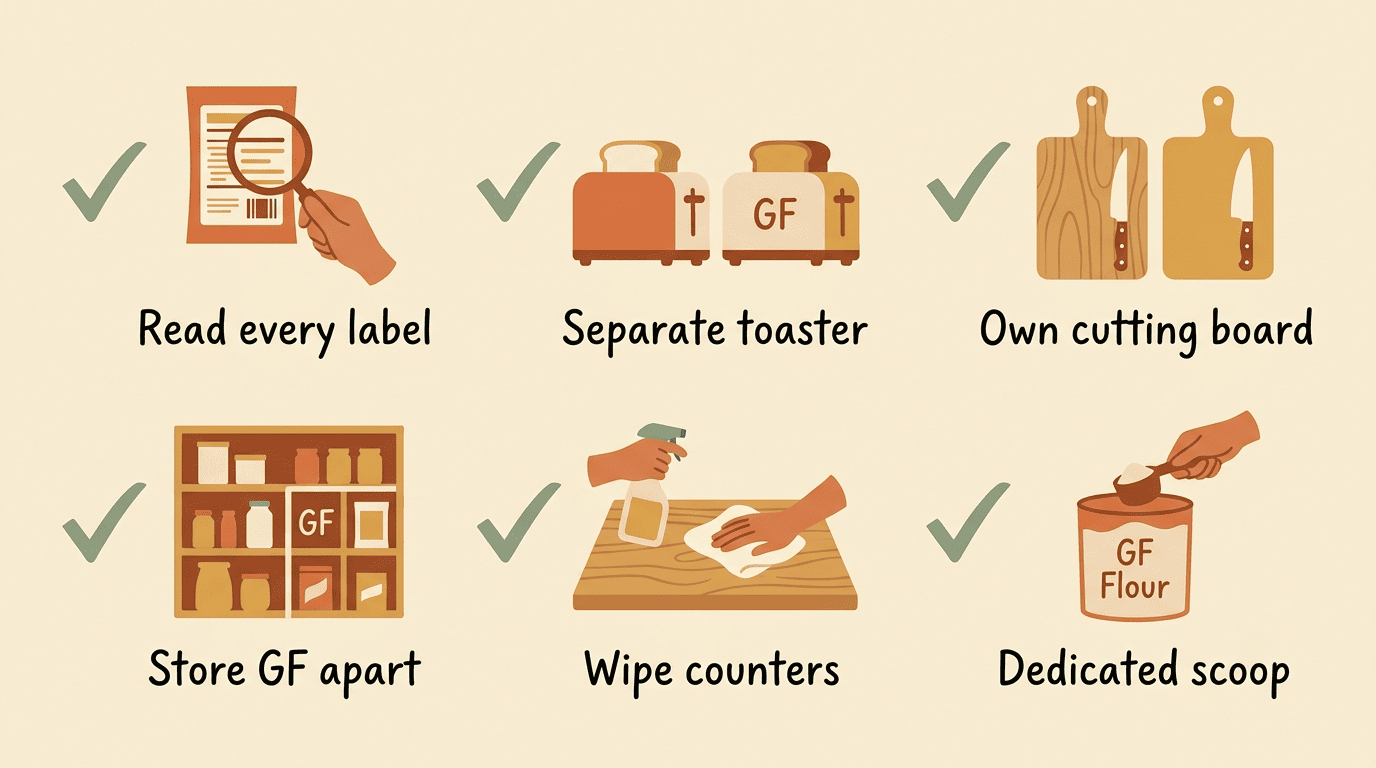
A handful of steps make any gluten-free kitchen meaningfully safer, whether you’re cooking from an AI-generated recipe or your grandmother’s:
- Read the label on every packaged ingredient, every time — formulations change without notice.
- Look specifically for a “gluten-free” claim or certification seal, not just the absence of the word “wheat.”
- Keep a separate toaster, cutting board, and wooden utensils for gluten-free prep.
- Store gluten-free flour, bread, and pasta away from their gluten-containing counterparts.
- Wipe down counters and reset a shared workspace before starting a gluten-free dish.
- Scoop from bulk bins with a dedicated utensil, since shared scoops are a common contamination point.
- When eating out or trying a new packaged product, confirm safety with a doctor or registered dietitian if you’re unsure.
A safety note for celiac disease
For celiac disease, even trace cross-contact — a shared toaster, a wooden spoon that touched regular bread, flour dust in the air, a bulk bin scooped with the wrong utensil — can cause real harm, so an AI recipe is a starting point, not a medical clearance. An AI gluten-free recipe generator is good at picking safe ingredients on paper, but it can’t read the label on the box in your pantry or verify your counters are clean. Always verify every packaged ingredient carries a gluten-free label, keep gluten-free prep and utensils separate from the rest of the kitchen, and confirm your plan with a doctor or registered dietitian, particularly if you’re newly diagnosed.
Following a gluten-free diet can relieve celiac disease symptoms and heal damage to the small intestine.
National Institute of Diabetes and Digestive and Kidney Diseases (NIH)
The National Institute of Diabetes and Digestive and Kidney Diseases (NIH) estimates celiac disease affects roughly 1 in 100 people worldwide, which is part of why the FDA continues to refine its rules around cross-contact — the agency opened a request for information on the topic in January 2026. For everyday kitchen habits that reduce contamination risk beyond labeling, food safety basics from FoodSafety.gov cover cleaning, storage, and prep separation in more detail than any recipe card can.
Gluten-Free Dishes an AI Generator Can Whip Up
Seeing what actually comes out the other end makes the whole process less abstract.
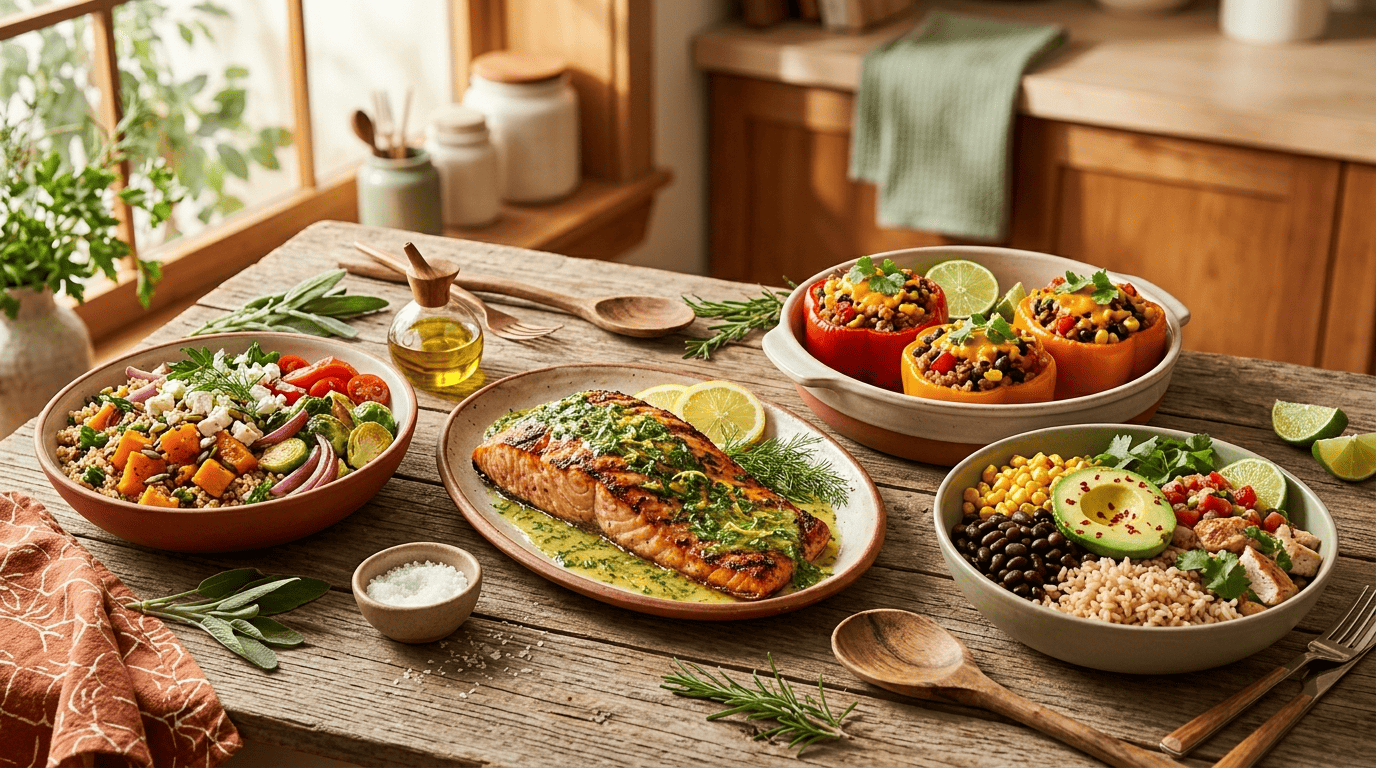
Naturally gluten-free favorites
Many great dishes are already gluten-free without any substitution at all:
- Quinoa salad with roasted vegetables
- Grilled salmon with a lemon-herb sauce
- Stuffed bell peppers with ground turkey
- Rice bowls with grilled chicken or tofu
This is where a generator shines with the least effort: it’s not solving a baking-chemistry problem, just turning what’s in your fridge into one of these naturally gluten-free combinations, seasoned and portioned to your taste.
Baked goods that need the flour swaps
Pancakes, muffins, pizza crust, and cookies are the harder category — these are where the blend-plus-xanthan-gum approach from the flour section does the heavy lifting, since baked structure depends on getting that ratio right.
An AI gluten-free recipe generator that’s been told your exact flour blend can rebalance liquids and rising time around it, which is a genuinely tedious calculation to do by hand every time you bake.