
AI Keto Recipe Generator: Instant Low-Carb, High-Fat Meals with the Macros Done for You
An AI recipe generator built for keto turns “what can I even eat today?” into a finished, macro-balanced meal in seconds — you tell it your ingredients, your carb limit, and your cravings, and it does the math. According to Wikipedia, the ketogenic diet is “a high-fat, adequate-protein, low-carbohydrate dietary therapy” that forces the body to burn fat instead of carbohydrates, and hitting that balance in real food is exactly what a keto AI is built to automate.

It’s like having a low-carb chef and a carb calculator working together — every recipe comes back with fat, protein, and net carbs per serving, plus swaps that keep the dish keto without you reaching for a spreadsheet. Whether you call it a keto recipe generator, an AI keto meal planner, or just your keto AI, the job is the same: fewer decisions, better math, dinner on the table.
What an AI Keto Recipe Generator Actually Does
An AI-powered keto recipe generator reads what you already have and what you’re aiming for, then writes a recipe that fits both. It’s not pulling a random dish off a list — it’s assembling a recipe around your carb ceiling and checking the ketogenic diet’s macro rules as it goes, using a food database (some tools draw on the Open Food Facts database of over 4 million products) to keep the nutrition numbers grounded in real ingredients rather than guesses.
You can typically feed it any combination of:
- The ingredients sitting in your fridge or pantry
- A meal type — breakfast, dinner, snack, dessert
- A net-carb ceiling for that specific dish
- Allergies or dislikes to avoid
- A cuisine or flavor profile you’re craving
From a prompt to a plated keto meal
Give it something like “dinner, under 8g net carbs, I have chicken thighs, spinach, and cream cheese,” and the generator returns a full recipe: ingredient list, step-by-step method, cook time, and per-serving fat, protein, and net carbs. Change one ingredient — swap the chicken thighs for salmon — and the tool recalculates every number instead of leaving you to do it by hand.
Why keto needs a generator (the macro math is annoying)
Keto isn’t just “low carb” — it’s a specific ratio of high fat, moderate protein, and very low carbs, typically around 70-80% fat, 10-20% protein, and 5-10% carbs of daily calories. Recalculating that split for every single recipe, ingredient swap, and portion size by hand gets old fast, which is exactly the gap an AI keto recipe generator fills: it does the recalculation instantly, every time you change something.
Keto Macros 101: Fat, Protein, and Very Few Carbs
The keto macro ratio is the whole game. Get the fat, protein, and carb split right and your body shifts toward burning fat for fuel; get it wrong — usually by eating too much protein or too many hidden carbs — and you stay out of ketosis no matter how “low carb” the meal looks on paper.
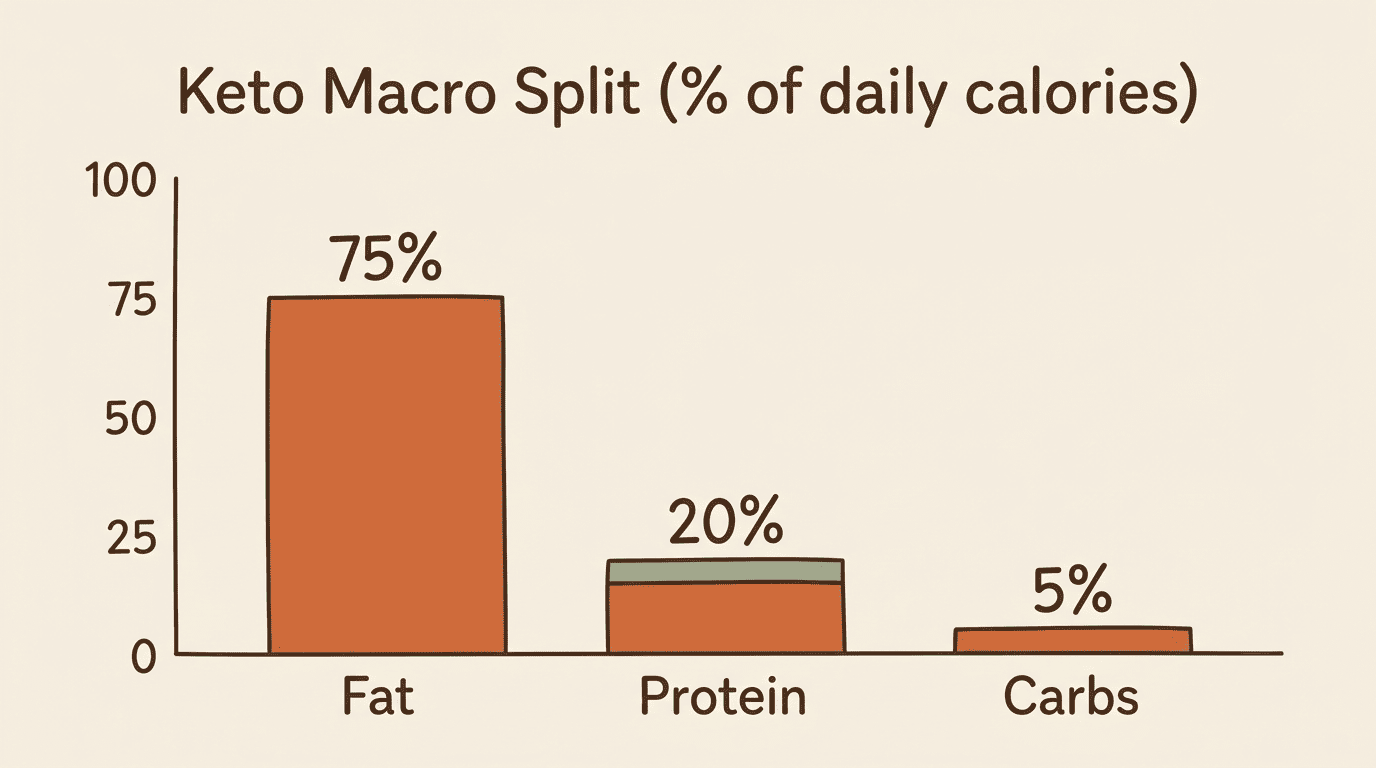
The keto ratio and why it matters
High fat isn’t a side effect of keto — it’s the fuel source. With carbohydrate intake this low, the body needs another energy source, and dietary fat (at roughly 9 calories per gram, versus 4 for protein and net carbs) fills that role. Protein sits in a narrower band too: too little and you lose muscle, too much and excess protein can be converted into glucose through gluconeogenesis, which works against ketosis. Most guidance points to roughly 0.6-1.0 grams of protein per pound of lean body mass as a reasonable target.
| Macro | Typical keto share | Grams on ~2,000 kcal/day |
|---|---|---|
| Fat | 70-80% of calories | ~165 g |
| Protein | 10-20% of calories | ~75 g |
| Net carbs | 5-10% of calories | ~40 g |
Source: Harvard T.H. Chan School of Public Health, The Nutrition Source
Setting your targets before you generate
Before an AI keto recipe generator can hit your numbers, it needs a target to hit. Many keto macro calculators start from the Mifflin-St Jeor formula — using your weight, height, age, and activity level to estimate daily calorie needs — and then split that total into the fat, protein, and carb grams above. Once those daily targets exist, the generator’s job becomes straightforward: keep every recipe’s per-serving macros inside that frame.
Net Carbs and Carb Counting (How the AI Keeps You in Ketosis)
Net carbs, not total carbs, are what an AI keto recipe generator actually tracks against your daily limit — and getting that number right is the difference between a recipe that keeps you in ketosis and one that quietly kicks you out of it.
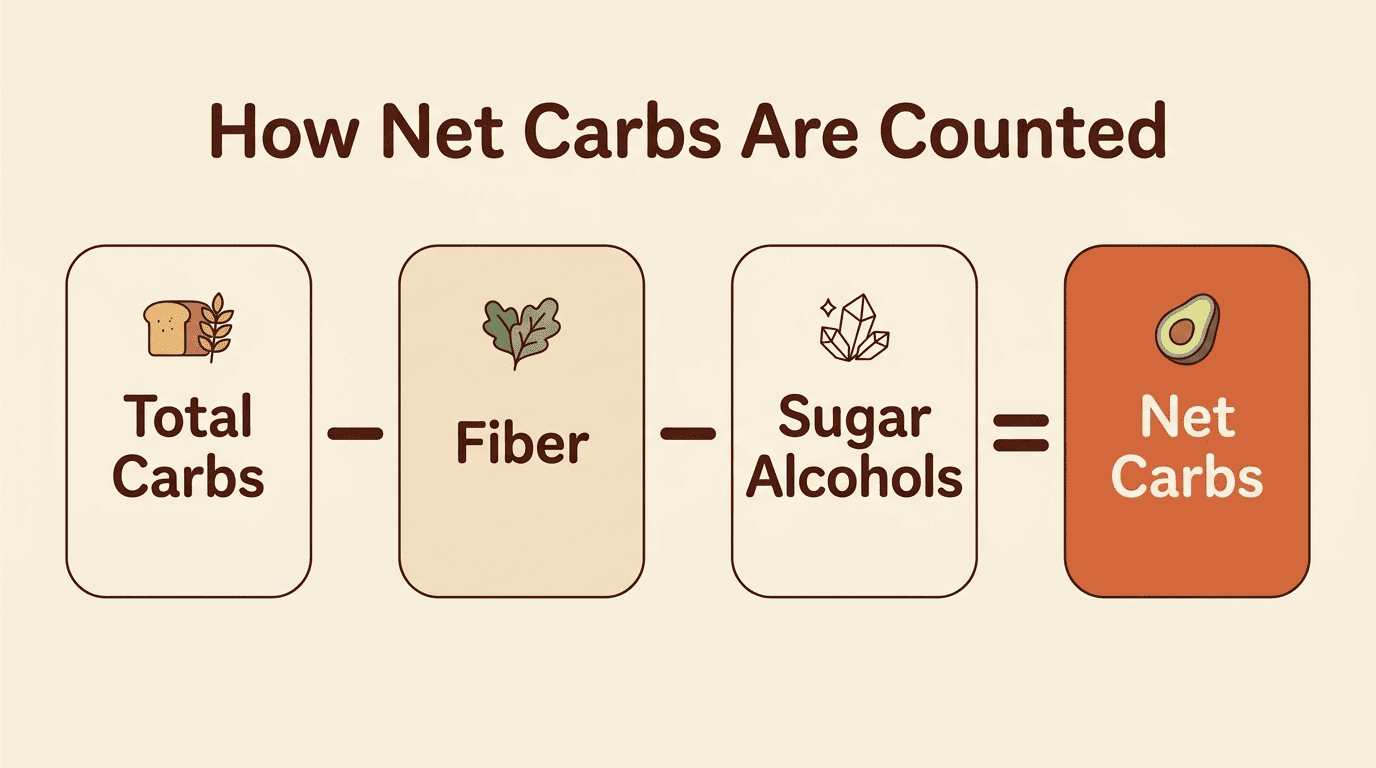
What “net carbs” means
The formula is simple: net carbs equal total carbs minus fiber and sugar alcohols, since fiber and most sugar alcohols aren’t digested and absorbed the way other carbohydrates are. Most people find ketosis somewhere under 20-50 grams of net carbs per day, with strict keto usually landing closer to 20 grams. A good AI keto recipe generator calculates net carbs per serving automatically, so you’re not doing subtraction at the dinner table.
A quick net-carb cheat sheet
Some staples are effectively free on a keto plate, while others eat up your daily allowance fast:
| Food (per 100g) | Net carbs |
|---|---|
| Avocado | ~2 g |
| Egg | <1 g |
| Beef or salmon | ~0 g |
| Spinach | ~1 g |
| Broccoli | ~4 g |
| Cauliflower | ~3 g |
| Cheese | 1-2 g |
| Nuts | 2-4 g |
Values are approximate; for precise nutrition data on specific foods, the USDA FoodData Central database is a reliable, free reference.
Worth knowing honestly: Harvard’s Nutrition Source describes “net carbs” as an unregulated, interchangeable term invented by food manufacturers as a marketing strategy — unlike “total carbohydrates,” a defined figure on official nutrition labels — so treat it as a useful planning shortcut rather than an exact science, and let your AI recipe generator’s per-serving numbers guide portion decisions rather than a printed package claim.
Smart Keto Swaps the Generator Makes for You
A big part of what makes a recipe “keto” isn’t the dish itself — it’s the ingredients standing in for the ones that would normally blow your carb budget. A good AI keto recipe generator makes these swaps automatically and recalculates the macros so you can see exactly what changed.
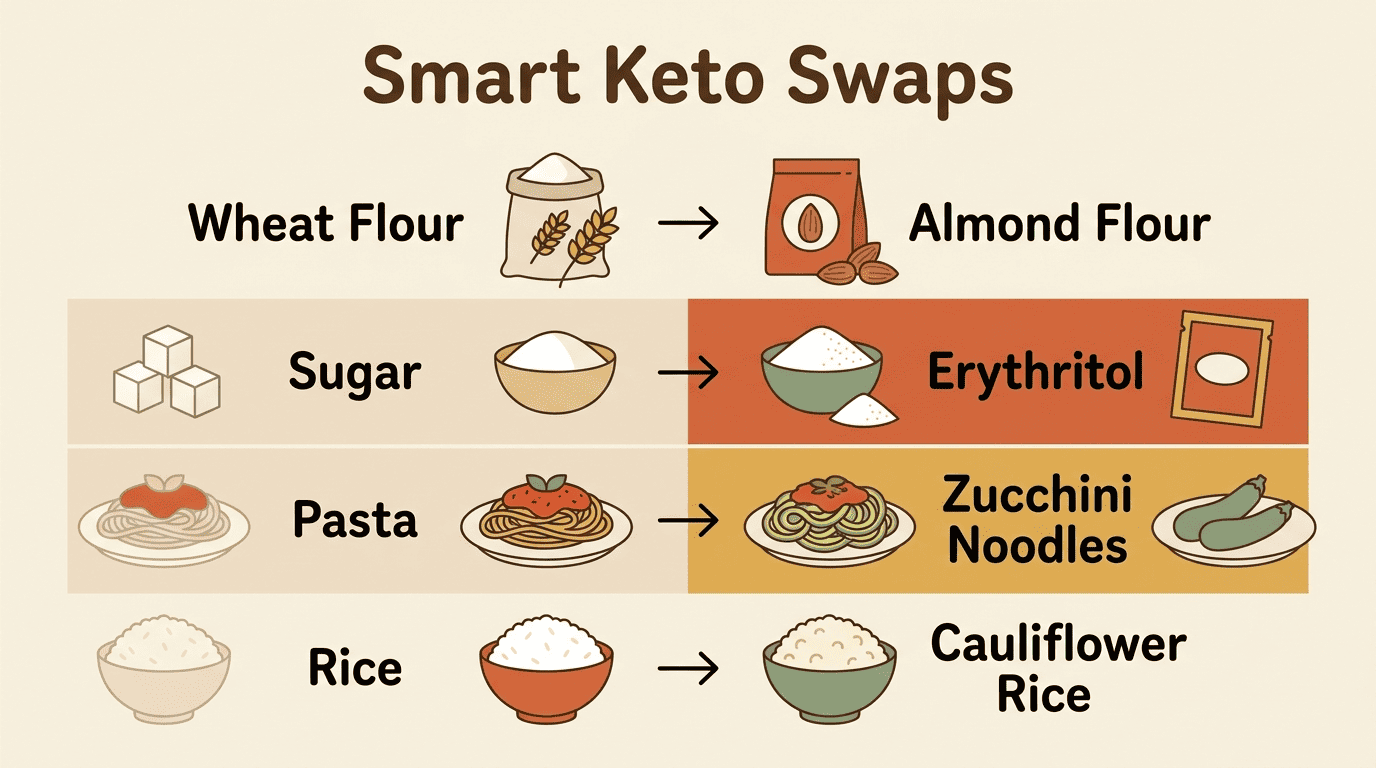
Wheat flour becomes almond or coconut flour. Both are lower in net carbs and higher in fat and fiber than wheat flour, which pushes a baked good’s macros closer to keto instead of away from it.
Sugar becomes erythritol, monk fruit, or allulose. These sweeteners add sweetness with close to zero net carbs, so a dessert can taste like dessert without spending your daily carb allowance.
Breadcrumbs become crushed pork rinds or parmesan. Both crisp up in the same way breadcrumbs do for a cutlet or casserole topping, minus the carbs.
Pasta becomes zucchini noodles or shirataki noodles. Both hold sauce well and mimic the texture of noodles at a fraction of the carb count.
Rice becomes cauliflower rice, and potatoes become turnip or radish. Both swaps keep the “starchy side dish” role on the plate without the starch.
Why the swap changes the macros
Almond flour, for example, isn’t just “lower carb” — it also brings more fat and fiber to the table than wheat flour, which is exactly the direction keto macros need to move. Erythritol behaves almost identically: it sweetens without contributing meaningful net carbs, since the body doesn’t metabolize it the way it metabolizes sugar. A keto recipe generator that’s doing its job shows you the before-and-after net carb count for the swap, not just the swapped ingredient itself.
How to Prompt an AI Keto Recipe Generator (Set Your Constraints)
The quality of what you get back depends heavily on what you put in. A vague prompt like “give me a keto dinner” produces a generic recipe; a specific one produces something you can actually cook tonight with what’s already in your kitchen.
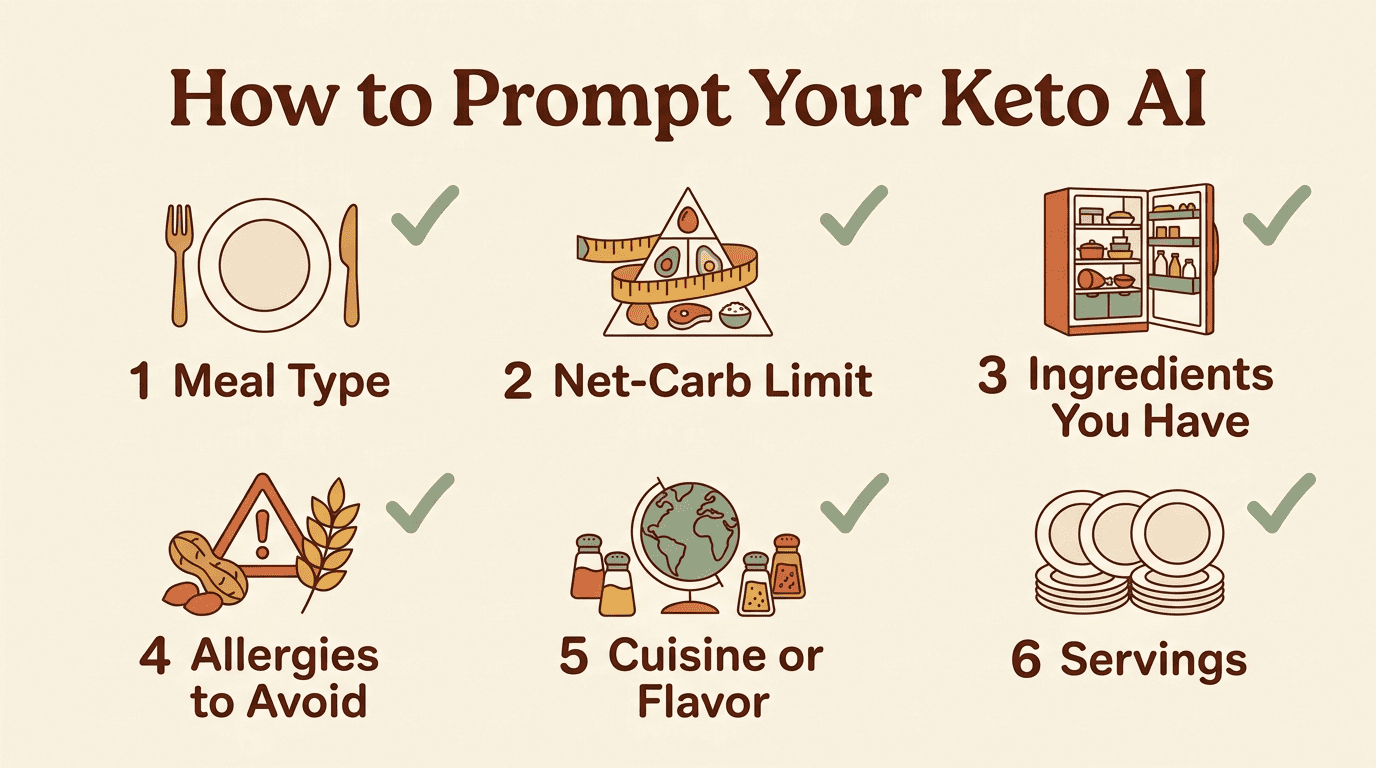
A prompt recipe that works every time
Here’s a formula that consistently gets useful results from a keto AI:
- State the meal type — breakfast, lunch, dinner, snack, or dessert.
- Set your net-carb limit for that dish, in grams.
- List the ingredients you already have on hand.
- Flag any allergies, dislikes, or ingredients to avoid.
- Add a cuisine or flavor direction — Italian, Mexican, comfort food, whatever you’re craving.
- Mention servings and any extra constraint, like dairy-free, nut-free, or a budget cap.
Something like “dinner, under 10g net carbs, dairy-free, I have shrimp and zucchini, Thai-inspired, serves 2” gives an AI recipe generator everything it needs to return a recipe that actually fits your night, instead of a recipe you have to modify before you can cook it.

Dialing in restrictions and allergies
Carb limits aren’t one-size-fits-all — strict keto sits around 20 grams of net carbs a day, while a more moderate approach might allow 30-50 grams. Some generators let you set that ceiling directly, along with filters for common allergens — often around eight allergy and preference filters to work with. If you’re allergic to tree nuts, a good generator swaps almond flour for a sunflower-seed or coconut-based alternative instead of just flagging the recipe as unsuitable — the point is to keep the dish keto and safe at the same time.
Keto Dishes an AI Can Whip Up (Real Examples)
The range of what an AI keto recipe generator can produce spans the whole day, not just dinner. A few examples of what typically comes back, with rough per-serving numbers:
- Breakfast: cream-cheese scrambled eggs with chives, or a bacon-avocado bowl — both easily under 5g net carbs per serving
- Dinner: garlic-butter salmon with cauliflower mash, or chicken Alfredo over shirataki noodles — both commonly land in the 6-10g net carb range
- Dessert: almond-flour brownies sweetened with erythritol, or no-bake keto cheesecake fat bombs — both built to stay under 5g net carbs per serving
Every one of these is a case where the “hard part” — hitting the carb ceiling while still tasting like the real thing — is handled by the generator’s ingredient swaps and macro math, not by you counting grams with a food scale.
A Friendly Note: Keto Isn’t for Everyone
Keto has a long medical history worth knowing. It didn’t start as a weight-loss trend — the ketogenic diet was originally developed about a century ago, in the 1920s, as a therapy for children with refractory epilepsy, using a strict 4:1 ratio of fat to combined protein and carbohydrate under close medical supervision. That medical version is a very different thing from the more flexible approach most people follow for weight or energy goals today.
That history matters because it’s a reminder that keto is a real metabolic intervention, not just a recipe style. Harvard’s Nutrition Source is upfront about the trade-offs of staying on it long-term:
Some negative side effects of a long-term ketogenic diet have been suggested, including increased risk of kidney stones and osteoporosis, and increased blood levels of uric acid.
Harvard T.H. Chan School of Public Health, The Nutrition Source
That’s worth knowing, not worth panicking over — but worth factoring in if you’re planning to stay on keto for months rather than weeks.
If any of the following apply to you, it’s worth checking in with a doctor or a registered dietitian before diving into keto, rather than relying on an AI recipe generator alone:
- You’re pregnant or breastfeeding
- You have type 1 diabetes or another condition affecting blood sugar regulation
- You have kidney or liver disease
- You have a rare metabolic disorder, such as a fatty-acid oxidation disorder
- You’re on medication where diet changes could affect dosing
None of this means keto is dangerous for most healthy adults — it means it’s a real dietary shift, and a quick conversation with a doctor first is a small step that can save a lot of trouble later. An AI keto recipe generator is there to make good-tasting, macro-balanced food easier to cook; it isn’t a substitute for medical advice, and it isn’t designed as treatment for any diagnosed condition.