
AI High-Protein Recipe Generator: Hit Your Protein Goal Without the Guesswork
“I need more protein” turns into an actual dinner the moment you hand it to an AI recipe generator — give it your ingredients and a protein target, and it hands back a recipe with the macros already worked out. No more squinting at a nutrition label to guess whether dinner covers what you need.
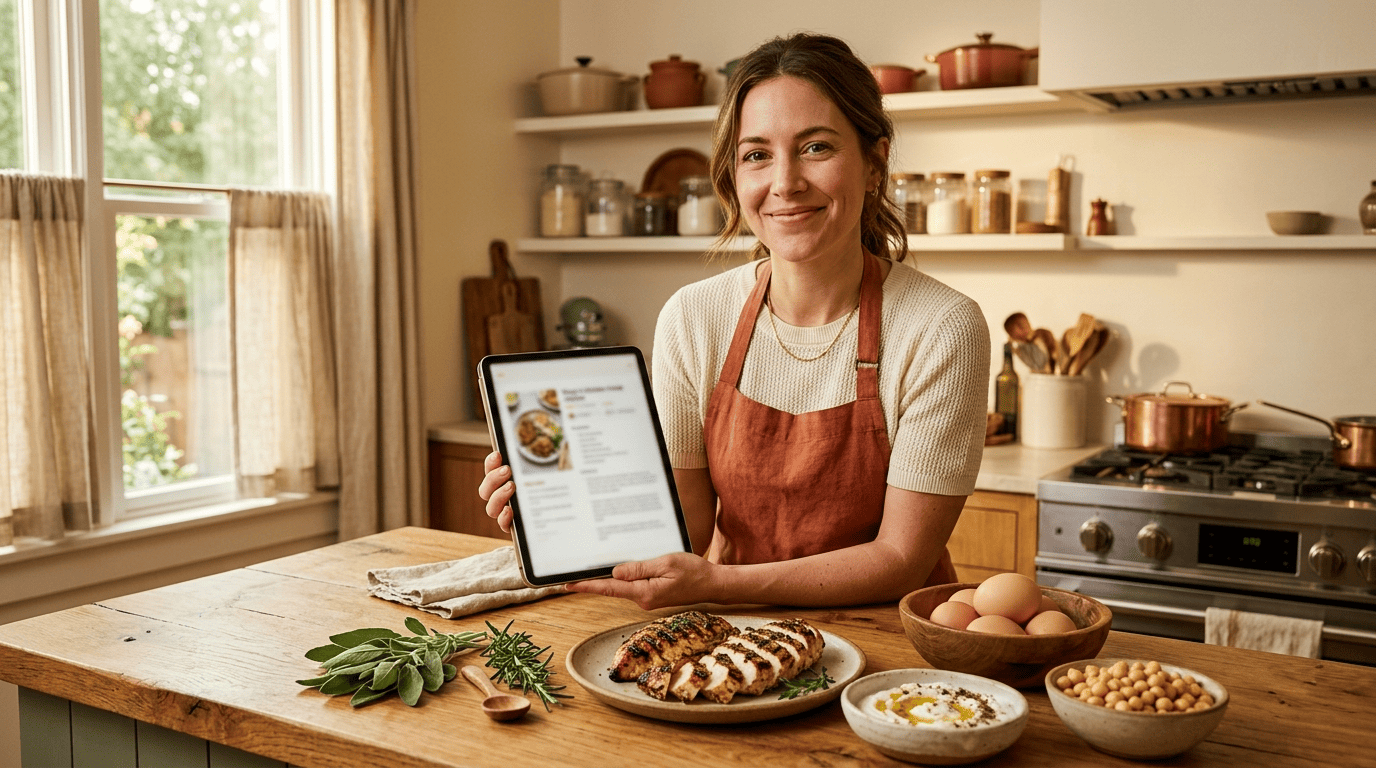
This guide covers how much protein you actually need, the foods that get you there fast, and exactly how to prompt an AI so every recipe lands on your number. Friendly, practical, no calorie-counting stress.
What an AI High-Protein Recipe Generator Actually Does
A high-protein recipe generator works from what you already have on hand. You feed it a short list of ingredients, pick a macro focus, and it does the composing — no browsing required.
From ingredients + a goal to a full recipe
You give it what’s in your fridge — chicken, eggs, canned chickpeas, Greek yogurt — pick a “high protein” focus, set servings and cook time, and it returns a step-by-step recipe with an estimated protein, carb, and fat breakdown per serving. Tools like these let you set a Macro Focus alongside dietary presets, so a vegetarian filter and a protein target can run at the same time. One thing worth remembering: the nutrition numbers an AI kitchen assistant gives you are estimates built from ingredient databases, not lab-measured values from your actual pan.
Why it beats scrolling recipe blogs
No sifting through a 2,000-word life story before you get to the ingredient list. You state the constraint — 35 g protein, 20 minutes, no dairy — and an AI recipe maker composes around it, offering swaps built in when you’re missing something. That’s the practical edge over a search-and-scroll routine: the recipe is built to your number from the first draft, not adjusted after the fact.
How Much Protein Do You Actually Need?
Before you start typing prompts, it helps to know what number you’re actually chasing. The math is simpler than most fitness content makes it sound.
The baseline: RDA and a quick per-meal math
The U.S. Recommended Dietary Allowance for protein is 0.8 grams per kilogram of body weight per day — about 0.36 g per pound — and that’s described by the Harvard T.H. Chan School of Public Health’s Nutrition Source as the minimum most sedentary adults need to avoid deficiency, not necessarily an optimal target. A 150 lb (68 kg) person lands near 54 g a day. According to Wikipedia’s entry on protein (nutrient), that RDA figure is calculated with a safety margin built in for population-wide variation. Spread across three meals, that ~54 g baseline works out to roughly 18 g each — active people spreading a higher target (say 100+ g/day) land closer to 25-35 g per meal, an easy number to hand a protein recipe generator.
| Body weight | RDA baseline (0.8 g/kg) | Active/strength range (1.2-2.0 g/kg) |
|---|---|---|
| 120 lb (54 kg) | ~44 g/day | 65-109 g/day |
| 150 lb (68 kg) | ~54 g/day | 82-136 g/day |
| 180 lb (82 kg) | ~65 g/day | 98-164 g/day |
| 200 lb (91 kg) | ~73 g/day | 109-182 g/day |
When you need more (and when to check with a pro)
Active people, strength trainers, older adults, and pregnant people often need more than the baseline — commonly cited ranges run 1.2-2.0 g/kg for athletes, a range echoed across sports-nutrition guidance. These are general figures, not a prescription: if you have kidney concerns or another medical condition, talk to a doctor or registered dietitian before loading up on protein. For everyday food-group guidance, USDA’s MyPlate is a solid free reference, and it’s not built around treating any specific disease — just balanced daily eating.
That RDA figure comes straight from the source nutrition scientists point to first:
The National Academy of Medicine recommends that adults get a minimum of 0.8 grams of protein for every kilogram of body weight per day, or just over 7 grams for every 20 pounds of body weight.
Harvard T.H. Chan School of Public Health, The Nutrition Source
That’s the floor, not a ceiling — it’s the number a generator defaults to unless you tell it otherwise.
Best High-Protein Foods to Feed the Generator
The better the ingredient list you type in, the better the recipe that comes back. A handful of staples do most of the heavy lifting.
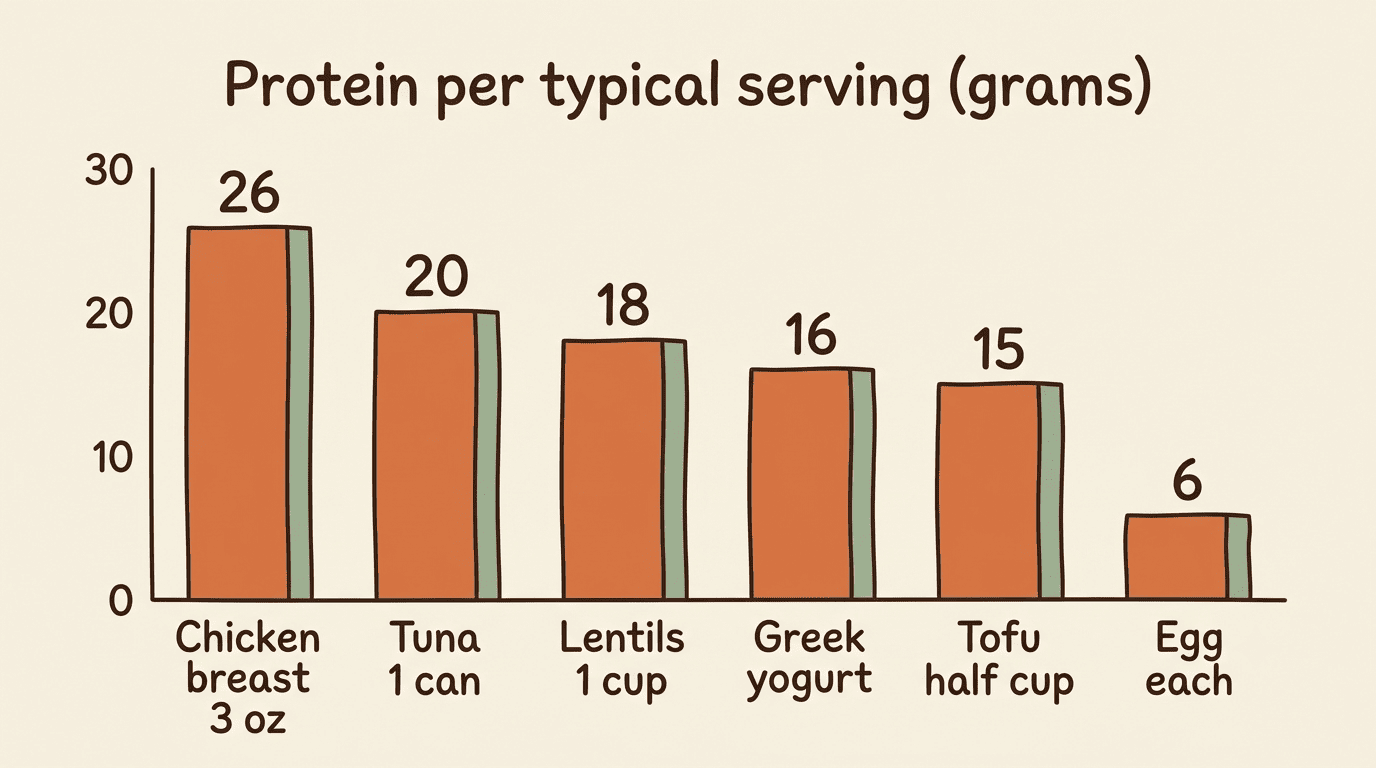
Chicken breast and other lean meats. About 26 g of protein per 3 oz cooked serving, with minimal fat if you’re watching that too — the single most reliable entry to drop into any prompt.
Canned tuna and salmon. Roughly 20 g per can, shelf-stable, and one of the fastest ways to hit a number without turning on the stove.
Eggs. About 6 g each, cheap, and flexible enough to anchor breakfast, lunch, or a quick scramble-based dinner.
Greek yogurt and cottage cheese. Greek yogurt runs 15-17 g per ¾ cup; cottage cheese comes in a bit lower, around 12-14 g per half-cup — both double as a base for sauces or a stand-alone snack.
Lentils, beans, and tofu. Cooked lentils or beans deliver about 18 g per cup, tofu and tempeh run 10-20 g depending on the cut, and pairing two plant sources gives a fuller amino acid profile for vegetarian prompts. The Harvard Nutrition Source’s protein guidance is a good starting point if you want the fuller science behind plant-protein pairing.
Animal sources: meat, fish, eggs, dairy
Chicken breast, canned tuna or salmon, eggs, Greek yogurt, and cottage cheese are the densest, easiest wins to hand an AI kitchen assistant — they’re consistent from package to package, so the macro estimate stays close to reality.
Plant sources: legumes, tofu, and more
Lentils and beans, tofu and tempeh, edamame, chickpeas, and quinoa round out a vegetarian or flex prompt. Pairing two plant sources — say, rice and beans, or hummus and quinoa — gets closer to a complete amino profile than relying on just one.
| Food | Protein per typical serving |
|---|---|
| Chicken breast | ~26 g per 3 oz |
| Canned tuna or salmon | ~20 g per can |
| Eggs | ~6 g each |
| Greek yogurt | ~15-17 g per ¾ cup |
| Lentils or beans (cooked) | ~18 g per cup |
| Tofu | ~10-20 g per ½ cup |
How to Prompt the AI for a High-Protein Recipe
A vague request gets a vague recipe. A specific one gets exact grams per serving on the first try.
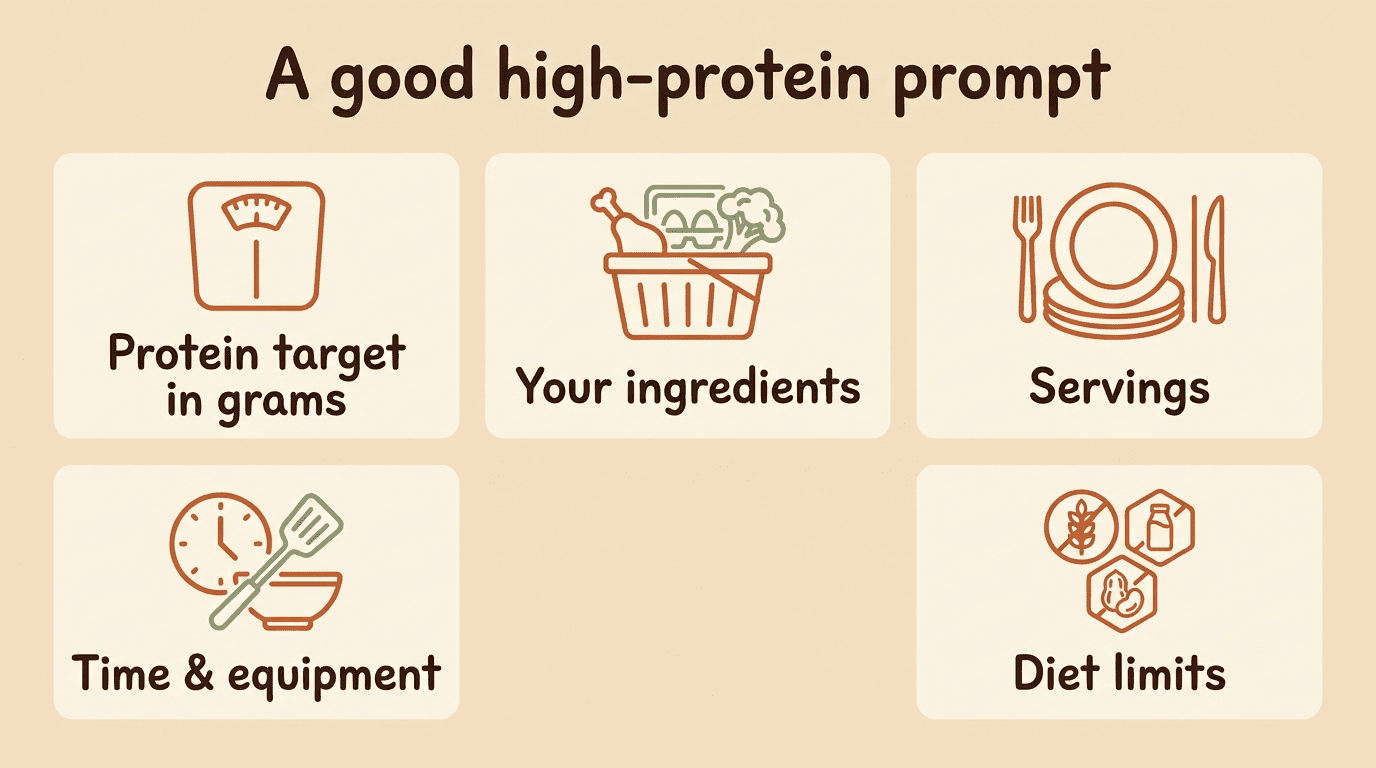
The 5 things every good prompt includes
- A protein target, stated as a number — “at least 35 g protein per serving,” not “high protein.”
- Your actual ingredients, listed by name.
- Servings — how many people or meals you’re cooking for.
- Time and equipment — 20 minutes, air fryer, one pan, whatever applies.
- Any diet limits — dairy-free, no red meat, vegetarian.
Then ask it to “show the macro breakdown” and “suggest a swap if I’m missing something” — those two lines are what separate a generic recipe generator from one working with you toward a specific gram count.
Copy-paste prompt templates
A fridge-cleanout prompt: “I have chicken thighs, spinach, canned chickpeas, and eggs. Build a 30-minute dinner with at least 35 g protein per serving, 2 servings, and show the macro breakdown.”
A meal-prep-batch prompt: “Give me a 5-day high-protein meal prep plan hitting 120 g protein per day, using chicken breast, tofu, and Greek yogurt, with batch-cooking instructions.”
A vegetarian prompt: “Vegetarian dinner, no eggs, using lentils and tofu, at least 30 g protein per serving, 25 minutes, one pan.”
Three starting points to copy and adjust:
- Fridge-cleanout: chicken thighs, spinach, canned chickpeas, eggs — 30 minutes, 35 g protein per serving.
- Meal-prep batch: chicken breast, tofu, Greek yogurt — 5-day plan, 120 g protein per day.
- Vegetarian, no eggs: lentils and tofu — 25 minutes, one pan, 30 g protein per serving.
A typical response comes back with a full recipe plus a line like “Estimated per serving: 38 g protein, 32 g carbs, 14 g fat” — that’s the payoff of stating the number up front instead of hoping the recipe happens to land close.
Example High-Protein Dishes AI Can Build
Seeing a few finished examples makes the prompting habit click faster than reading rules about it.
Quick weeknight wins
A Greek-yogurt chicken bowl comes in around 40 g of protein per serving — the AI leans on marinated chicken plus a yogurt-based sauce to stack protein twice in one dish. A tuna-white-bean salad lands near 30 g by combining two protein sources that don’t need cooking. An egg-and-cottage-cheese scramble hits roughly 28 g by folding cottage cheese into the eggs before they hit the pan. A tofu stir-fry reaches about 25 g when the tofu is pressed first so it holds its texture.
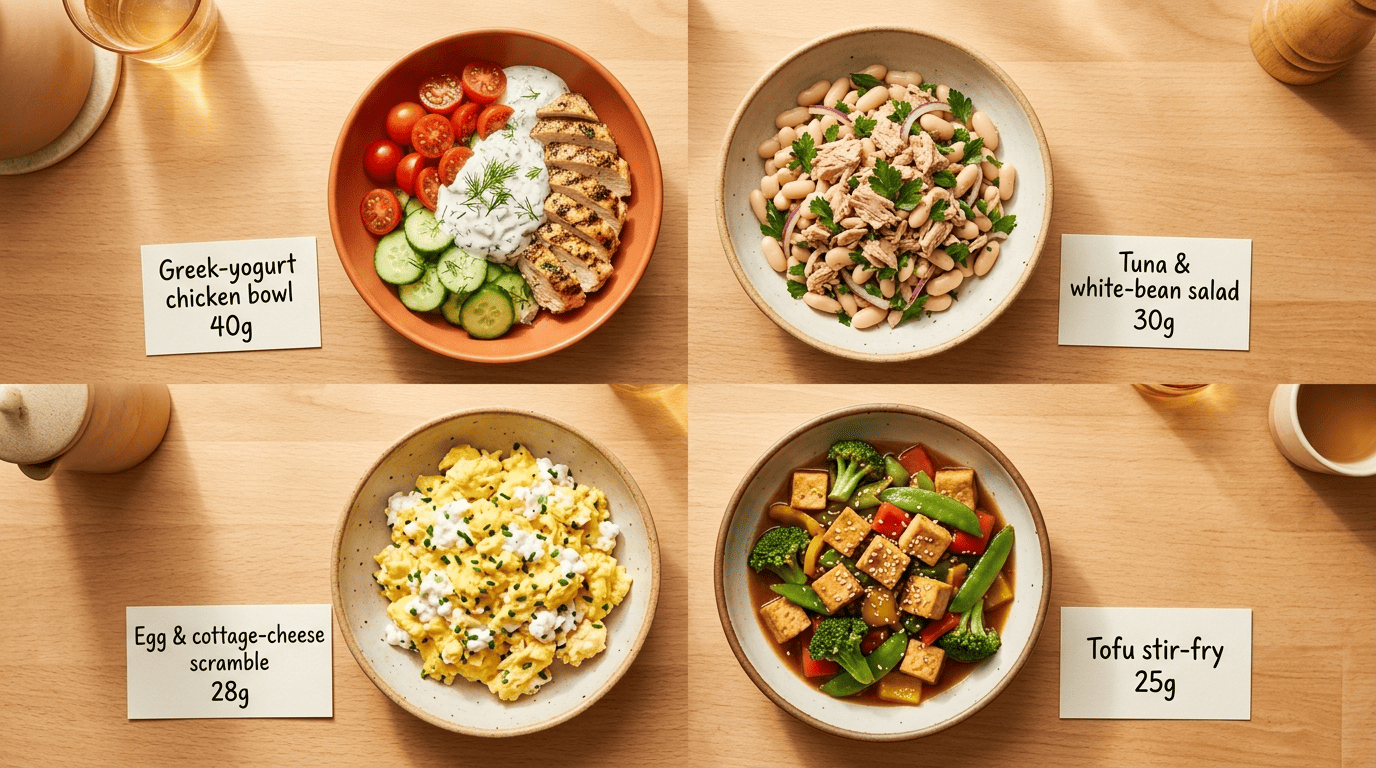
Four weeknight dishes worth trying first:
- Greek-yogurt chicken bowl — ~40 g protein
- Tuna-white-bean salad — ~30 g protein
- Egg-and-cottage-cheese scramble — ~28 g protein
- Tofu stir-fry — ~25 g protein
Breakfast and snacks that stack protein
Overnight oats built with Greek yogurt and a scoop of whey can reach about 30 g before lunch even starts. Cottage cheese bowls, edamame, and hard-boiled eggs are the easiest snack-level asks. If mornings are usually your weak point, try telling the assistant to “front-load protein at breakfast” — it’ll lean on eggs and dairy first rather than saving the heavy hitters for dinner.
- Overnight oats with Greek yogurt and whey — ~30 g protein
- Cottage cheese bowl with fruit
- Edamame, steamed and salted
- Hard-boiled eggs, two at a time
High-Protein Meal Prep with AI
Meal prep is where a protein target actually gets easier to hit consistently, because you’re solving for the week instead of one meal at a time.
Batch a week around your number
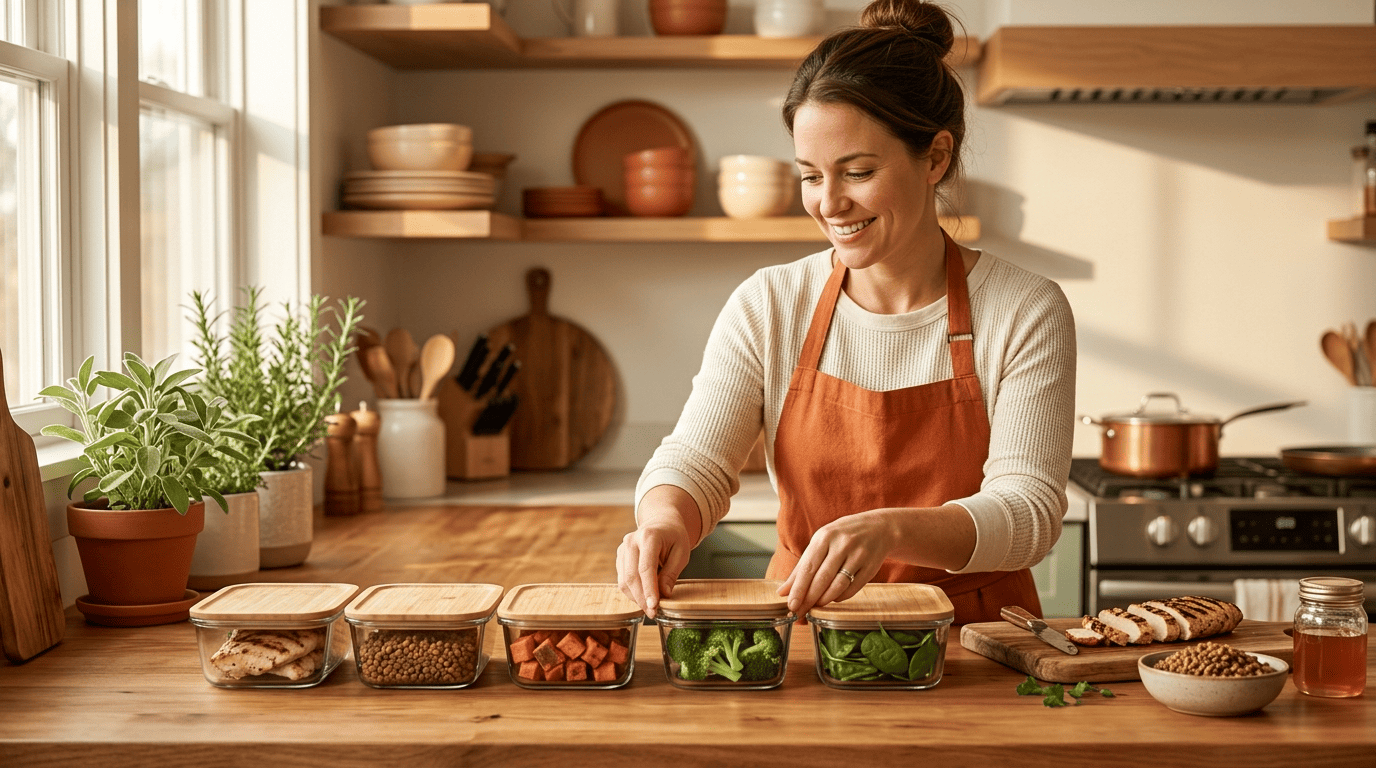
Ask the AI for a “5-day high-protein meal prep hitting 120 g/day” and it distributes that total across meals — typically landing around 25-35 g per meal so nothing feels lopsided. Cook proteins in bulk (a tray of chicken, a pot of lentils), then portion into containers so the day’s total is already accounted for before you open the fridge.
Food-safety quick note
A friendly reminder that applies no matter which generator you use: cook poultry to an internal temperature of 165°F (74°C), and refrigerate cooked batches promptly, using them within 3-4 days. That guidance comes straight from USDA’s FoodSafety.gov, which is worth a bookmark if you batch-cook regularly — it’s not about being anxious over dinner, just keeping a week’s worth of prepped chicken actually safe to eat by Thursday.